Sea Level Rise is a huge threat to humanity, as it causes many national security and environmental refugee, health, economic impacts and will leave areas uninhabitable. The danger posed by Sea Level Rise is very significant. In this blog post I will be discussing Sea Level Rise, the projections, causes, current data, who vulnerable and what we can do about it.
Currently the sea is rising at 3.3 millimeters per year. That may not seem like much but it has some serious implications and this rate has been increasing (NASA Climate Change). The average sea level has risen 8-9 inches between 1880 and today, and just in the last 25 years a third of that has occurred. I say average because the sea doesn’t rise at a uniform rate because of meteorological, geological, and oceangraphical reasons for example the strength of winds and ocean currents and land rising from the last ice age (climate.gov) (Magnusson).

Currently several areas have been affected by sea level rise. Let’s start our field trip in Southern Florida. In Southern Florida, the sea level has risen to a point that now “King Tides” or significantly high tides are flooding communities that usually are not affected by them. This water is flooding parking lots, streets and into homes and businesses. The flooding is becoming worse and more common. This also is a threat to water lines, from saltwater getting into the drinking water supply. Florida also has porous soil that makes water more easily flow through the soil (Tampa Bay Times). Another area is Bangladesh where the seas are flooding rural areas. This leaves soil infertile and erodes the soil. Each year 50,000 to 200,000 people are displaced by erosion and sea level rise and that isn’t counting those who leave after cyclones hit. This has created a situation of “environmental refugeeism”, where hundreds of thousands of Bangladeshis move to the city, Dhaka and end up in the city’s poorest areas. Scientists predict by 2050 17 percent of the country will be submerged and 20 million will be displaced. Dhaka isn’t immune to flooding either. Most that move live in nonpermanent shelters and have little to none potable water, have little to eat and bathe and drink from a river, in which trash and industrial waste and sewage are dumped straight into the river. The city doesn’t provide them with basic services because it doesn’t want them to be “permanent.” They work in jobs like a trash picker or in garment factories. Bangladesh isn’t a huge country, about the size of Iowa. Other than the sea Bangladesh is completely surrounded by India. India doesn’t really want anything to do with migrants from Bangladesh (National Geographic and Marcin Szczepanski.) Back in the US, in Louisiana a whole community of Native Americans is having to relocate. The community is called the Isle de Jean Charles. Sea Level Rise, and Soil Subsidence is pushing this community into the ocean. The tribe of Biloxi-Chitimacha-Choctaw Native Americans is having to move from their historical homeland as 2,000 square miles of Louisiana delta is disappearing. The island was in 1955 22,400 acres but now its only 320 acres, and it extremely close to losing its only access road. The US Department of Housing and Urban Development has given a $48 million relocation grant to relocate the community (Ted Jackson). Also communities in Alaska are succumbing to sea level rise, sea ice retreating, permafrost melting and coastal erosion. Most of these communities are also native communities (Oliver Milman). Also island nations in the Pacific are succumbing to sea level rise. One of them Kiribati is so much in danger is bought land in Fiji to relocate to when their home disappears beneath the waves. Sea Level Rise is reducing the ability to grow food and have fresh water. In New York City, Hurricane Sandy’s storm surge was made 11.4% worse than it would without sea level rise. And Hurricane Sandy isn’t alone, if Hurricane Katrina had climatic and the sea level factors of the 1900s, the storm surge would have been 15% to 60% lower.
Sea Level Rise is has two main causes, loss of glaciers and ice sheets and heat expansion. First Land-based ice for example on Greenland and Antarctica and Glaciers melts leading to a rise in the sea level. The two most worrying of these are the Greenland and West Antarctic Ice Sheets. If the Greenland Ice Sheet completely melted, the sea level would rise 6 meters or 20 feet. The Greenland Ice Sheet is 656,000 square miles. Summer melt on the Greenland Ice Sheet increased by 30% from 1979 to 2006. If the West Antarctic Ice Sheet melted sea levels would rise 3.2 meters. Together that would make more than 9.2 meters or 30 feet, something almost unimaginable (and that isn’t including mountain glaciers). These ice sheets are connected to the ocean by glaciers. Most worrying about West Antarctica Ice Sheet is that it sits below sea level and that warm ocean water meets the grounding line below the glacier’s ice tongue and making these glaciers unstable and if these collapsed it could lead to a gradual collapse of the entire ice sheet (National Snow and Ice Data Center) (Antarcticglaciers.org) (Carolyn Beeler). Glaciers are also melting at alarming rates. Nine thousand billion tons of ice melted between 1961 and 2016 from mountain glaciers. This could be 25 to 30% of sea level rise (Olivia Rosane). Another cause is warming waters. As waters warm from climate change, they expand leading to larger seas (climate.gov).
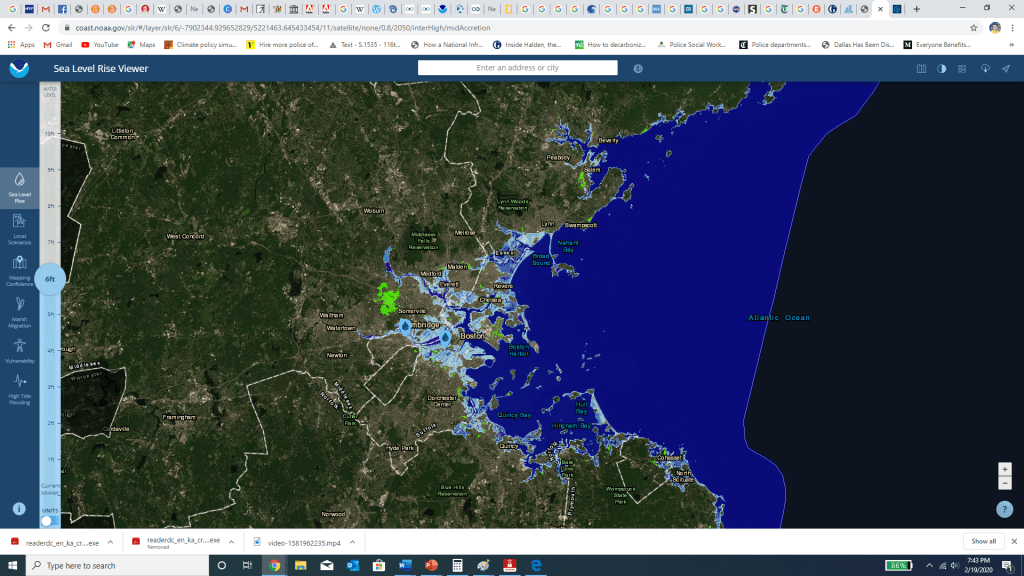
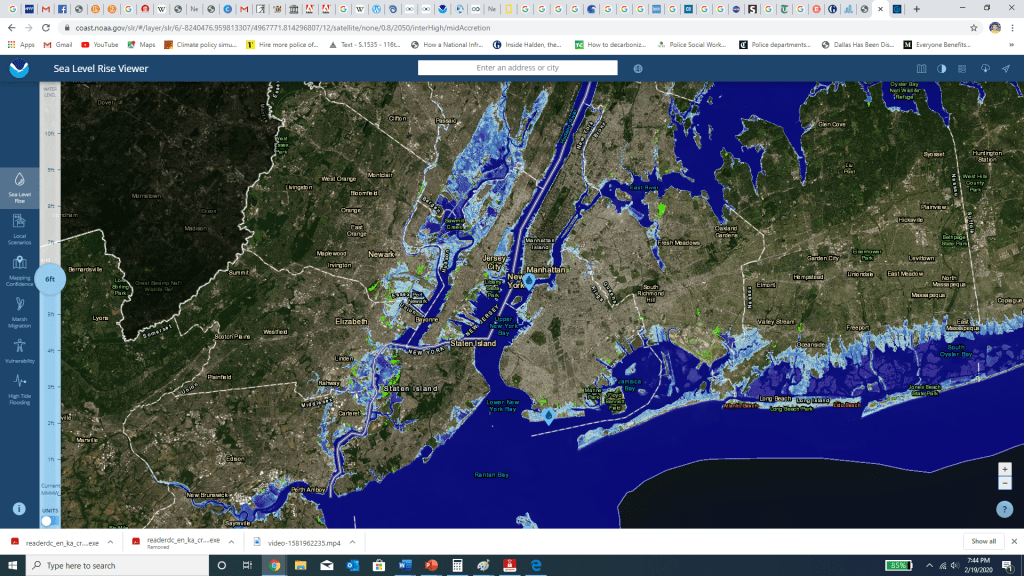
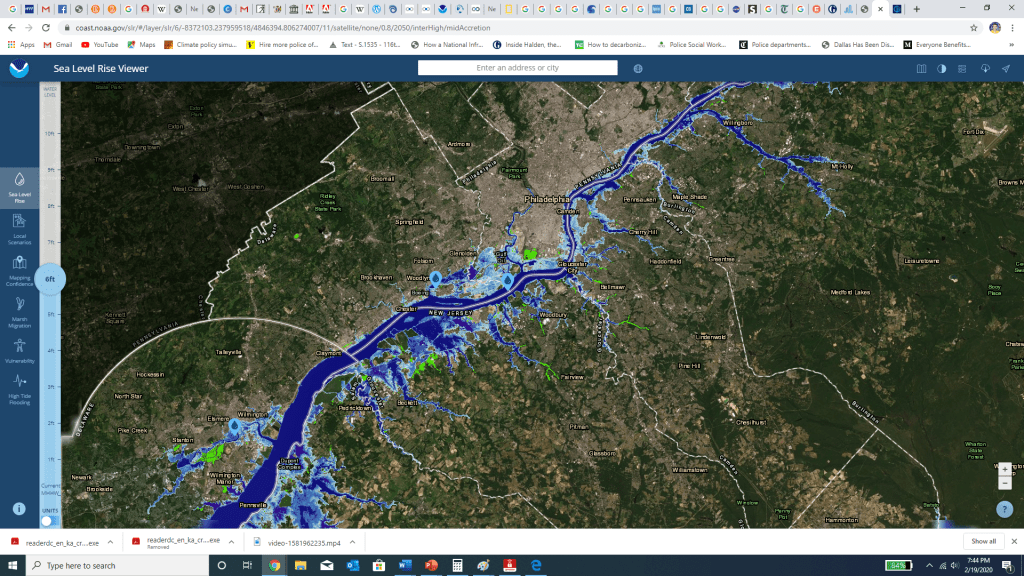
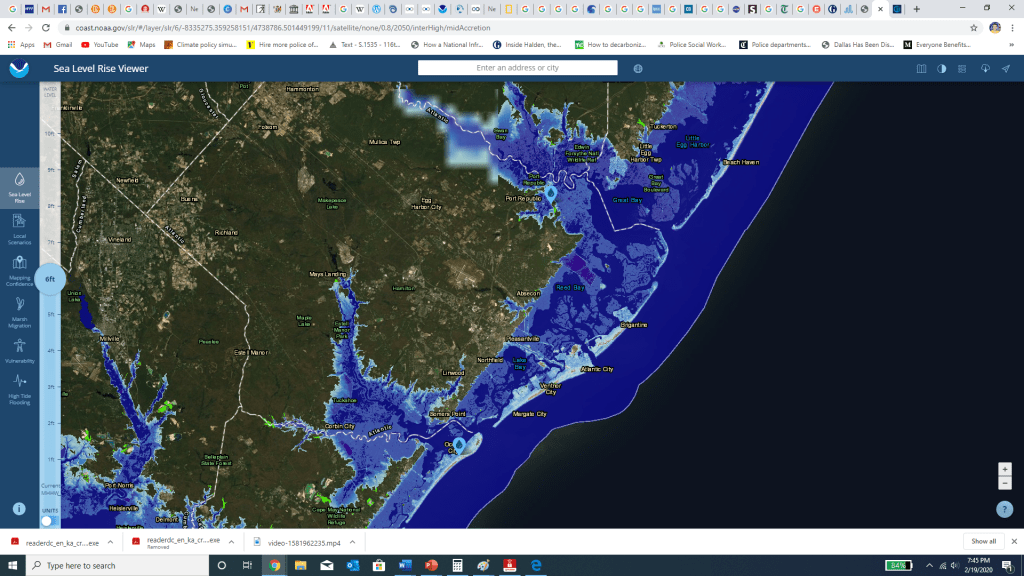
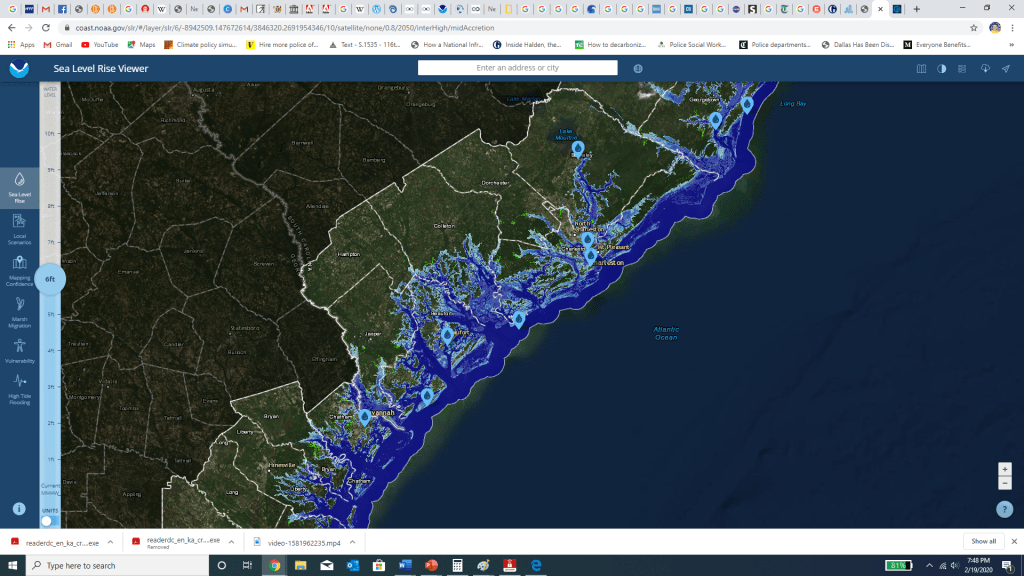
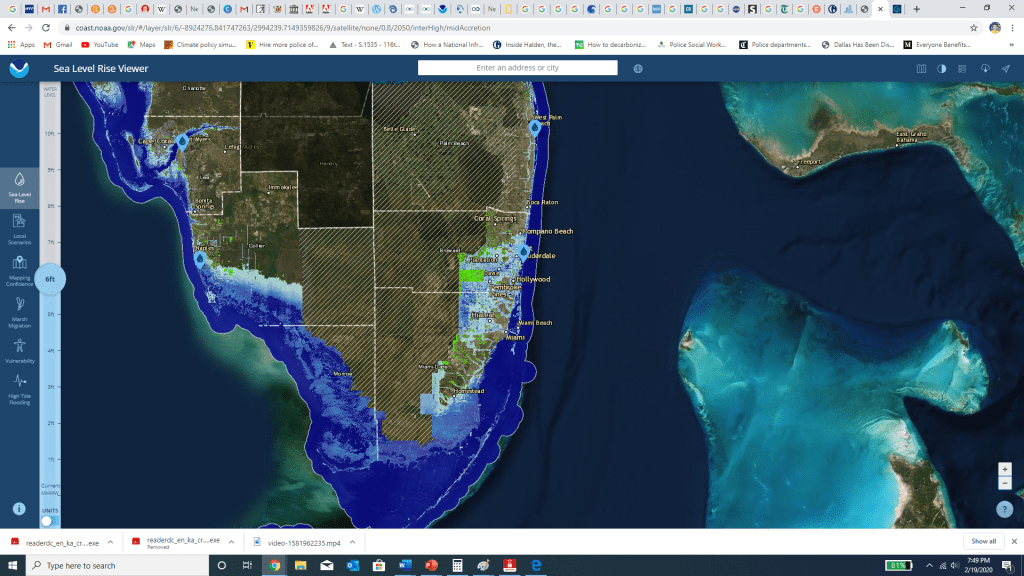
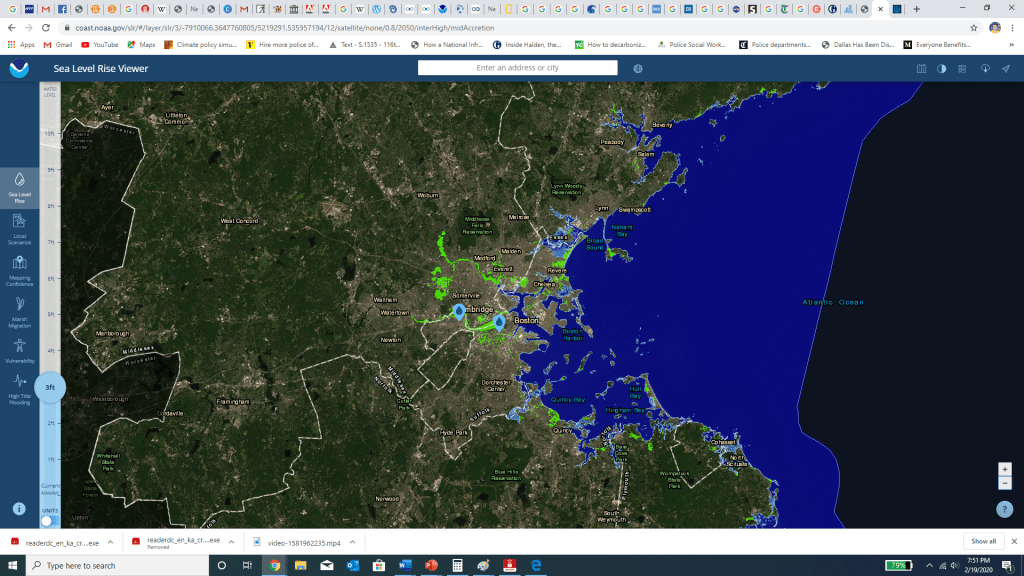
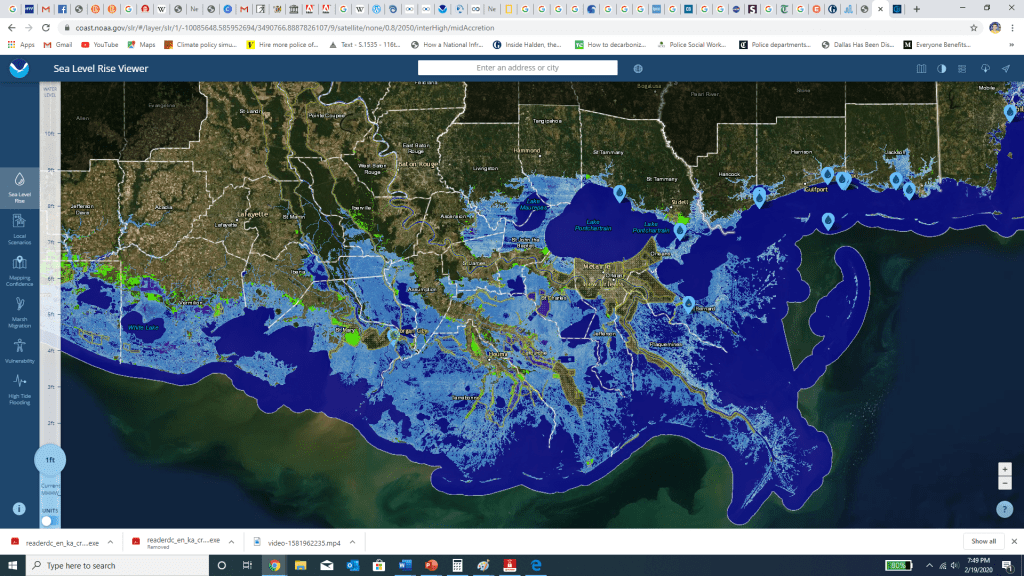
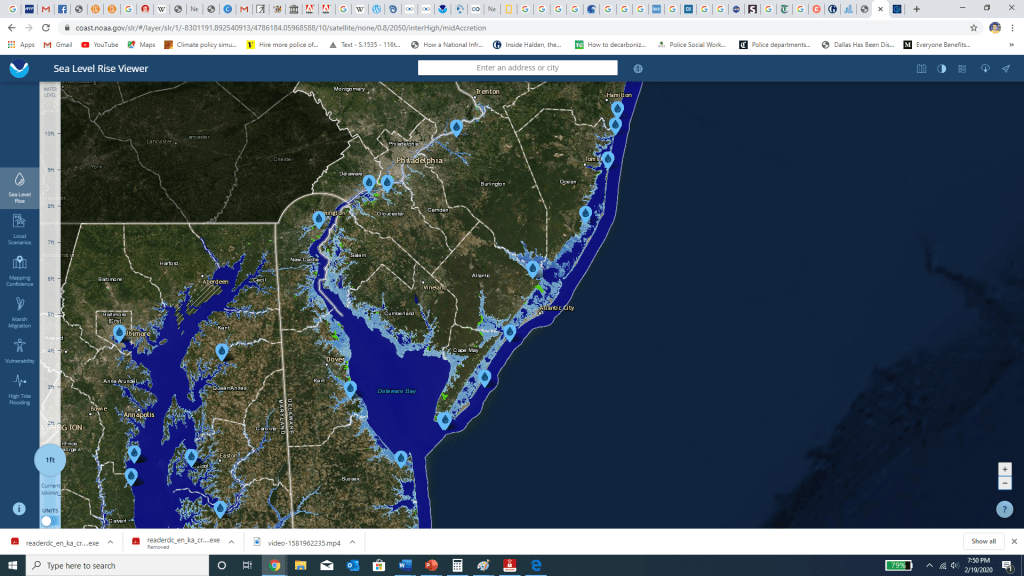
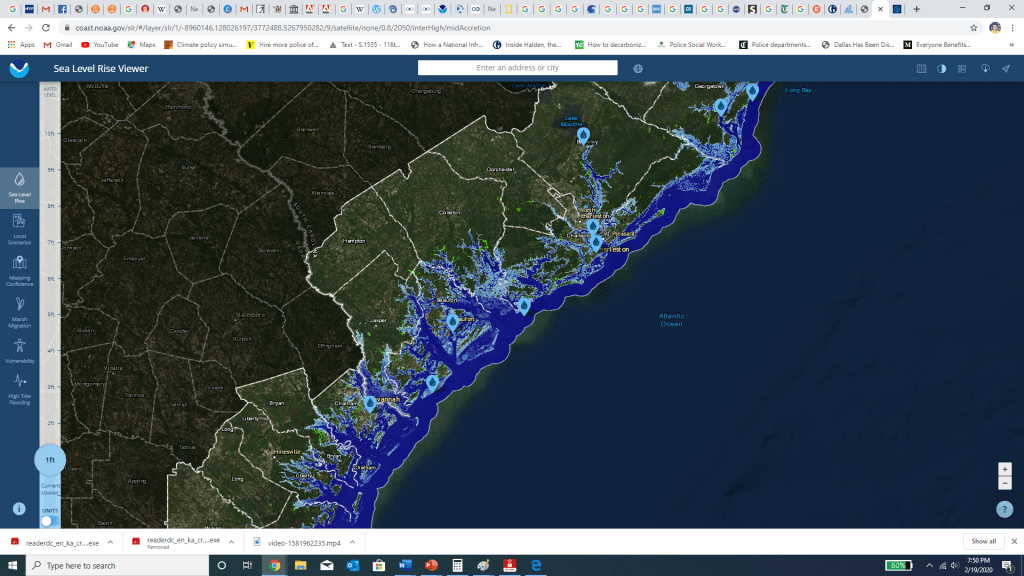
Current Average projections for the world average sea level from the Intergovernmental Panel on Climate Change is if we stay below 2 degrees Celsius of warming we’ll have a range of 1 to 2 feet, if go over 2 degree we will have a range 2 to 3.6 feet. But the IPCC also said in its “Special Report on Oceans and the Cryosphere” that 6 feet of sea level rise “cannot be ruled out.” Below I have some pictures of sea level rise in different parts of the world.
6 ft—Boston
6 ft—–New York City
6 ft—-Philadelphia
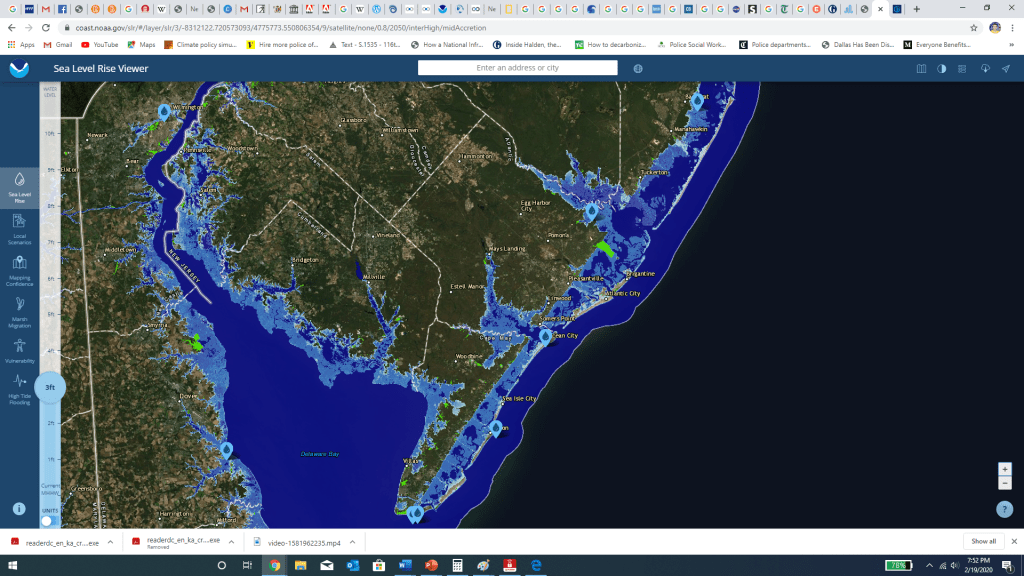
6 ft—–Atlantic City and New Jersey Shoreline
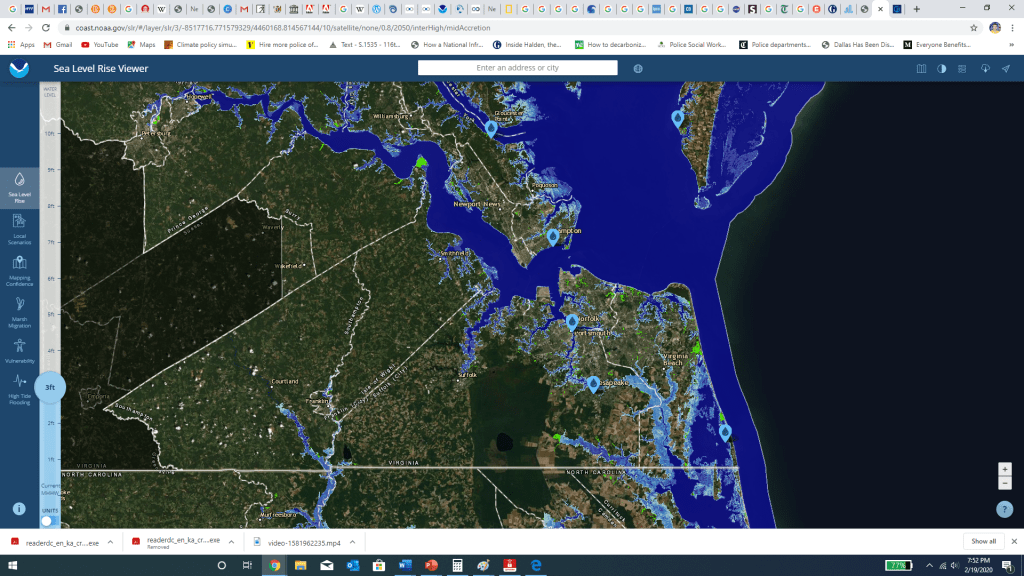
6 ft—-Norfolk Naval Base
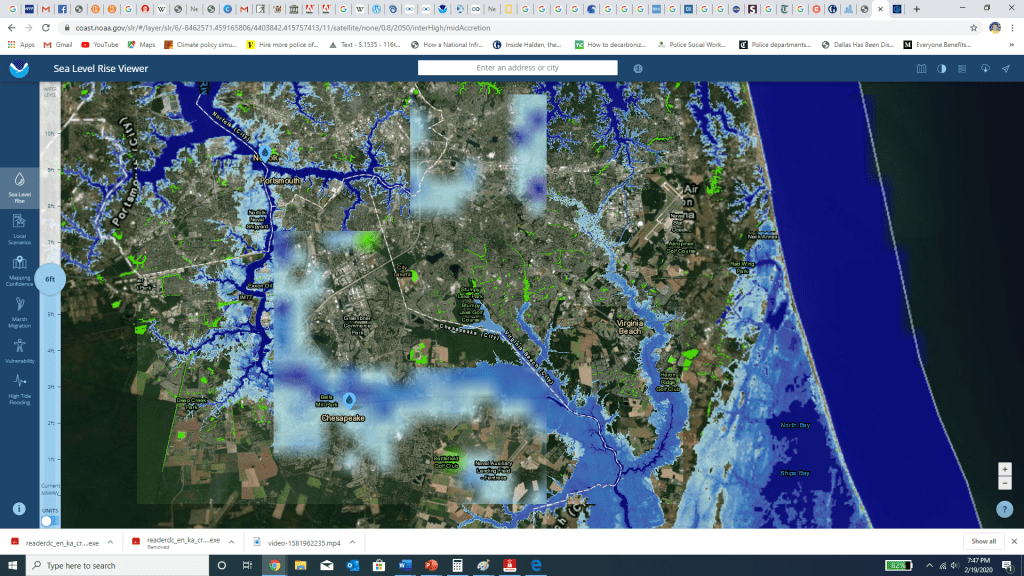
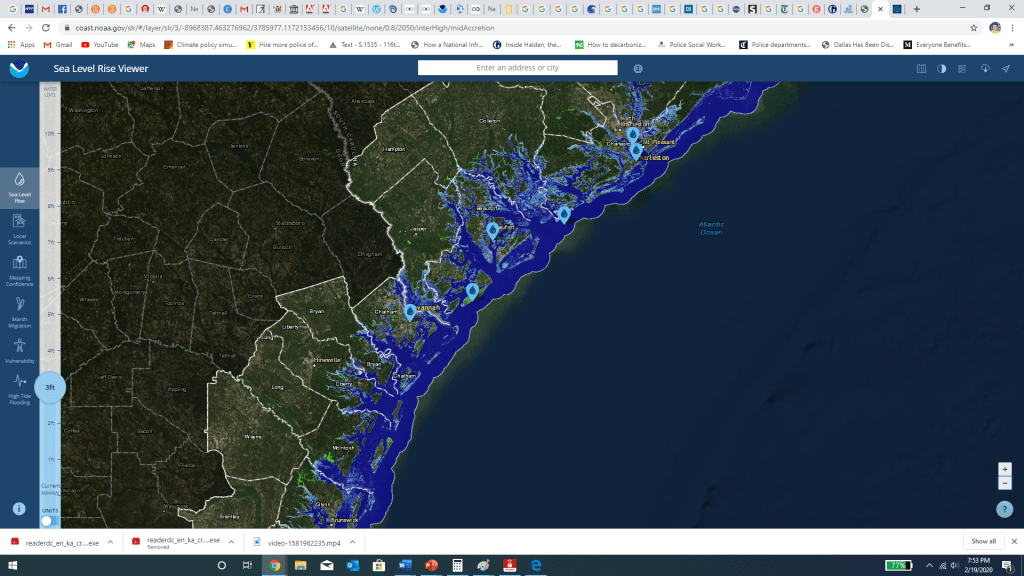
6 ft—–Savannah, Georgia and Charleston, South Carolina
6 ft—-Miami
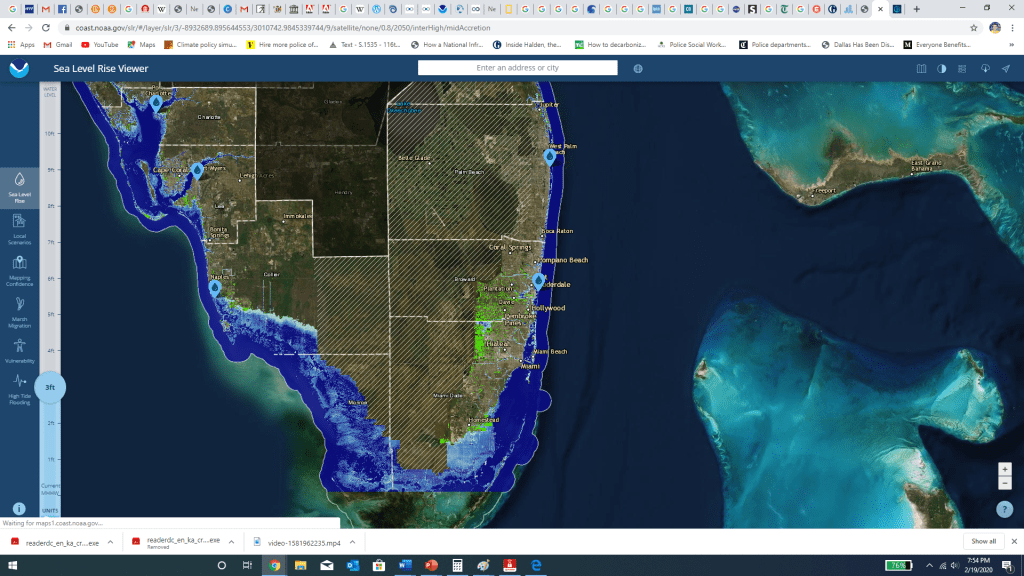
Florida 3 FT
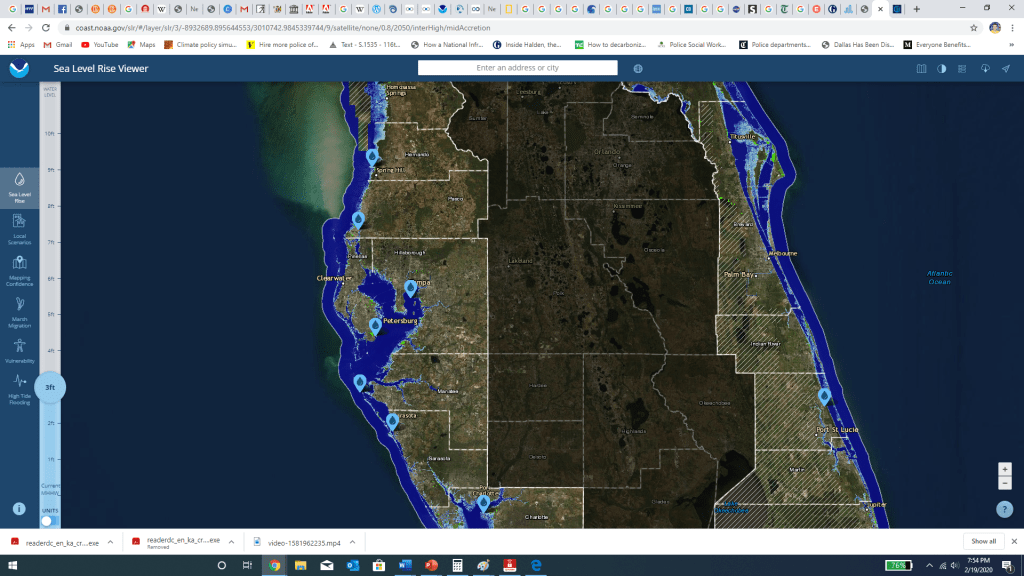
Charleston, South Carolina, 3ft
Norfolk Virginia 3ft
New Jersey Seaboard 3ft
Boston 3ft
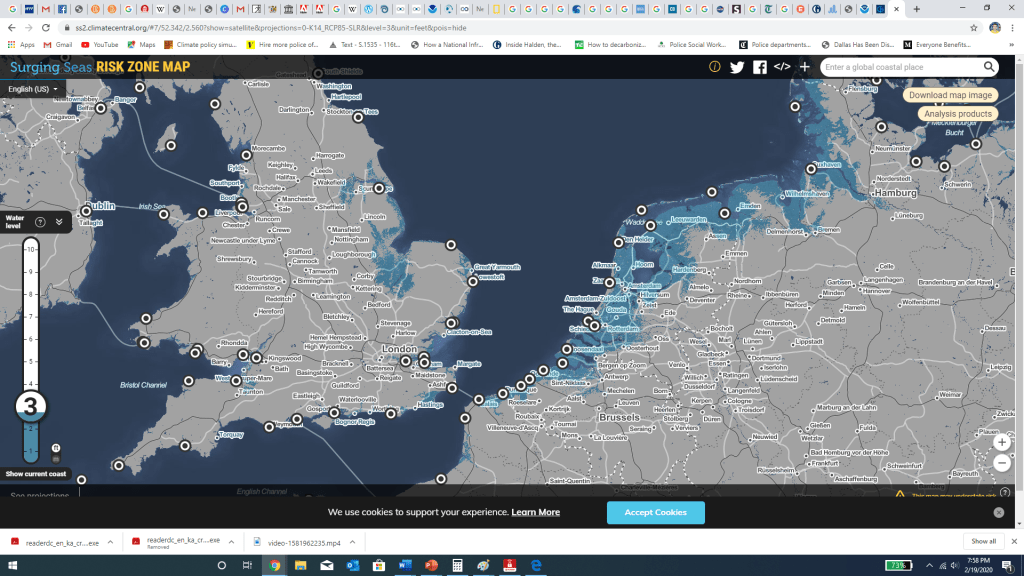
England and the Netherlands 3ft
Louisiana 1 ft
New Jersey Seaboard 1 ft
Charleston, South Carolina 1 ft
For southern Florida the IPCC predicts by 2030, 6 inches more sea level rise on average, and on the high end of scale NOAA predicts a foot. By 2060, the IPCC predicts 14 inches and NOAA predicts 2.8 feet. By 2100 the IPCC predicts 2.58 feet and NOAA predicts 6.75 feet.
Sea Level Rise brings with it a host of problems, first higher seas contribute to higher storm surge and larger flood areas during hurricanes and other large storms. For example what I said earlier with Hurricane Sandy. This can also contribute to coastal erosion and there but subsidence. The flooding can cause people to be stranded without help and will break down infrastructure. It can also kill people trying to swim or drive in the water.
Also a problem is that sea level rise will push people further inland causing fights over resources, and over land. This makes area more conflict prone and could bring us into wars. The US Department of Defense named climate change a “threat multiplier” for this reason. This is very serious concern and could be the worst impact climate change has. Also Sea Level Rise is harming military bases like the home of the US Atlantic Fleet, Norfolk.
The Loss of economic assets and since we are not being very keen to realize the impacts of sea level rise on our infrastructure and buildings, this could cause a large economic bubble, which could lead us into a depression or recession. Also globally the world economy could lose more than 4% of its GDP just from sea level rise, without further mitigation or adaptation.
Relocating communities because of sea level rise can cause problems in its own including mental health, social networks, historical heritage, water and food security, sanitation, and health care.
Last but not least there is saltwater intrusion which cause saltwater to seep into our water supply systems and leave areas without potable drinking water. This is a concern for many areas of the along the coast.
To adapt to Sea Level Rise there is a bunch of things we can do. To protect communities we can build dikes and seawalls and sea gates to protect areas. We can put buildings on stilts to allow the sea into areas while protecting our buildings. We can redirect water into areas for example parking lots and parks, and floating communities. We can use large pumps to pump out water from underground or from in our streets. We can retreat from the coast line and we should put money towards communities being able to do that. We can raise infrastructure to make sure critical infrastructure is not affected by flooding. We can invest in the water supply infrastructure to keep that safe. There is a lot of things we can do stop sea level rise but probably the most important one is reaching net zero emissions.

Thank you for visiting and looking at my blog post.
Sincerely,
Brendan Wissinger
https://www.climate.gov/news-features/understanding-climate/climate-change-global-sea-level
https://www.climatecentral.org/what-we-do/our-programs/sea-level-rise
https://oceanservice.noaa.gov/facts/sealevel.html
https://www.globalchange.gov/browse/indicators/global-sea-level-rise
https://sealevel.climatecentral.org/research/methods/projecting-sea-level-rise/
https://www.nationalgeographic.com/environment/global-warming/sea-level-rise/
https://ocean.si.edu/conservation/climate-change/map-boston-3-meter-sea-level-rise
https://toolkit.climate.gov/topics/coastal/storm-surge
Click to access DOE-OE_SLR%20Public%20Report_Final%20_2014-10-10.pdf
https://www.ucsusa.org/resources/underwater
https://www.climatecentral.org/news/adapting-to-sea-level-rise-could-save-trillions-by-2100-17034
https://www.weforum.org/agenda/2019/04/how-will-retreating-from-the-sea-affect-our-health
https://www.sciencedaily.com/releases/2020/01/200127134809.htm
https://e360.yale.edu/features/rising_waters_how_fast_and_how_far_will_sea_levels_rise
https://www.climatecentral.org/gallery/graphics/storm-surge-and-sea-level-rise-advancing-waters
https://www.businessinsider.com/sea-level-rise-3-feet-in-80-years-un-report-2019-9
https://www.neefusa.org/nature/water/groundwater-and-rising-seas
https://www.cgg.wa.gov.au/live/my-environment/coastal-hazard-risk-management-and-adapta
tion-planning/adapting-to-sea-level-rise.aspx
Click to access 15-117-NCCARFINFOGRAPHICS-5-03%2812Apr%29-UPLOADED.pdf
https://www.nrdc.org/onearth/bangladesh-country-underwater-culture-move
https://www.theguardian.com/us-news/2017/aug/10/alaska-coastal-towns-sea-level-rise-climate-change
https://www.theguardian.com/us-news/2017/aug/10/alaska-coastal-towns-sea-level-rise-climate-change
https://www.climate.gov/news-features/features/superstorm-sandy-and-sea-level-rise
https://www.climatesignals.org/events/hurricane-katrina-2005
https://nsidc.org/cryosphere/quickfacts/icesheets.html
https://interactive.pri.org/2019/05/antarctica/thwaites-glacier-collapse.html
https://www.weforum.org/agenda/2019/04/melting-glaciers-causing-25-to-30-of-sea-level-rise
https://www.nhc.noaa.gov/surge/
Surging Seas of Climate Central: https://ss2.climatecentral.org/#8/22.294/110.391?show=satellite&projections=1-K14_RCP85-SLR&level=6&unit=feet&pois=hide
Sea Level Rise Viewer of NOAA: https://coast.noaa.gov/digitalcoast/tools/slr.html
 Global Climate Change and Society
Brendan this is a great first post. My only concern here is that it might have been a bit lengthy, and if you can it’s best to embed the links at the end into your writing so that people can associate the links with the relevant information you present. I also think that your images could have been cropped so the peripheral icons and such from the program aren’t showing. Also you said you were presenting maps from different parts of the world, but you only presented coastal maps from the U.S.
LikeLike
Okay. Good point. I did present a map of England, and the Netherlands for 3 ft of Sea Level Rise. Its between Boston and Louisiana.
LikeLike