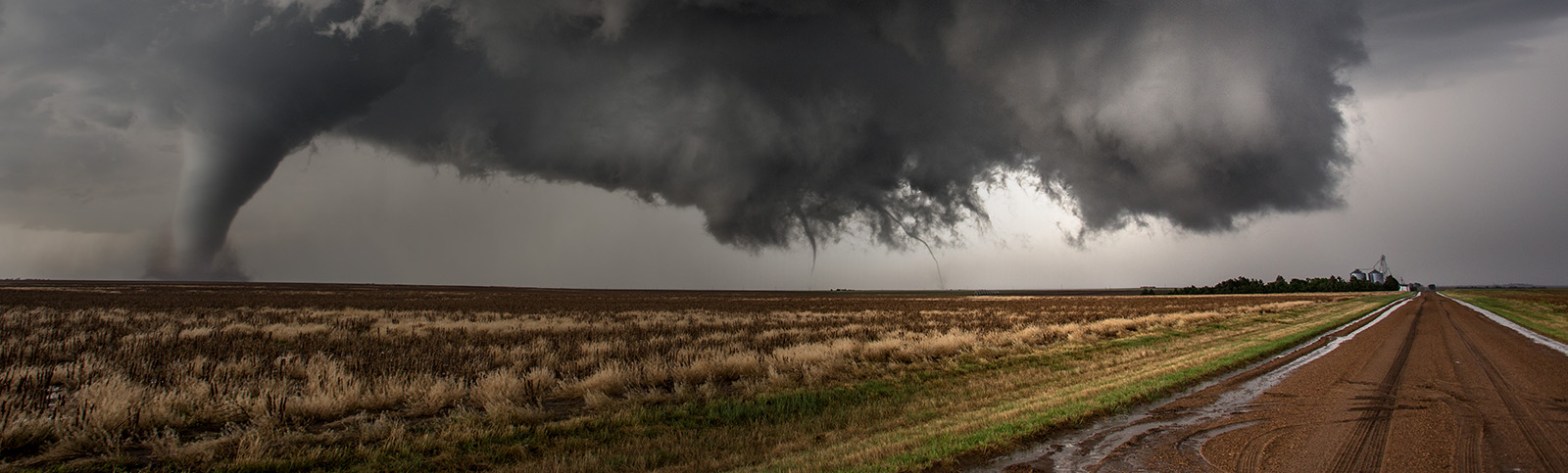
My fascinations reside within the chaos of severe weather, especially tornadoes. As I have educated myself more on the synoptic and global scales, I have asked myself many times how climate change will impact tornadoes. Will their winds intensify, and in return, cause more destruction? Will they mellow out and relieve the anxiety of the general public? With climate change having become a concept accepted by the majority of our nation, it is important that we understand what to expect in terms of day-to-day weather. Therefore, throughout this post, I will examine and explain tornado frequency, intensity, location, and how climate change is impacting each parameter.
North America: Rich with Ingredients
North America is home to most of the tornadoes that occur on our planet. More specifically, the atmosphere above the United States produces the bulk of tornadoes that are accounted for on an annual basis. More than 1,400 tornadic storms were recorded annually during the years of 2005-2015. The mid western region of the United States, commonly known as Tornado Alley, provides a conducive environment for these storms to generate. Tornado Alley’s thousands of miles of flat land are the common grounds for cool, dry air from the Rocky Mountains and Canada, and warm, moist air from the Gulf of Mexico. From this union, an updraft causes the warm air mass to lift into cooler regions of the atmosphere. However, the moisture from the warm air is conserved to then condense and form cumulonimbus clouds that deliver precipitation to the surface below them. Downdrafts and winds are delivered to Earth’s surface by vertical columns of cool air that bear a sinking motion. Thus, a thunderstorm is born. More importantly, the fact that these conditions of the United States allow for frequent thunderstorms serves as a catalyst for tornadic storms. Tornadoes are a product of supercells, which require instability, wind shear, and a lifting mechanism.
Change In Geographical Locations of Tornadoes
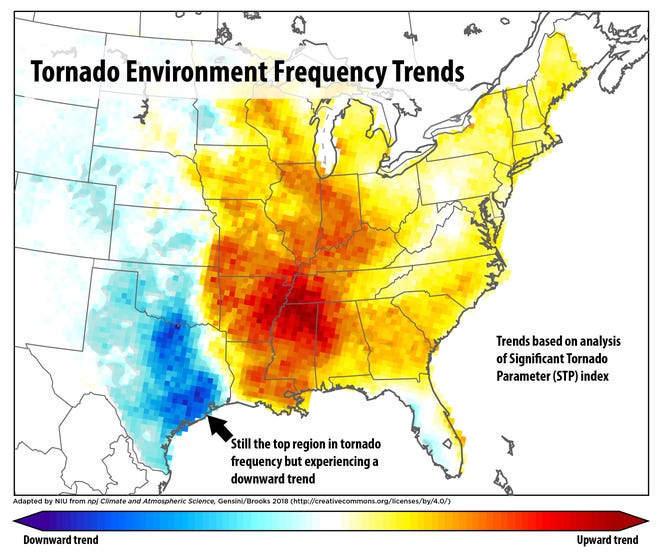
The fact that change and evolution of geological conditions are both time consuming processes means that tornadic activity will most likely remain within its current regions, for the most part. North America’s geographical features are expected to sustain their properties for years to come. With that being said, tornadoes will continue to occur within Tornado Alley, but their territory is anticipated to extend farther towards the eastern region. States that are predicted to have an increased trend in tornadic activity are Arkansas, Missouri, Illinois, Indiana, Alabama, and Mississippi. This shift is due to the fact that the changing climate is expected to claim the already limited moisture that the Southwest deserts possess, and in return, areas of dry air will migrate farther into Tornado Alley. Furthermore, climate models demonstrate that current wet environments will experience an increase in precipitation and moisture that correlate to climate change. Therefore, the Gulf of Mexico is a culprit of heightened precipitation and will be capable of instigating sufficient severe weather events with the eastward shift.
Will Storm Season Change?
The majority of tornadic storms typically conjure supercells that occur from May until mid to late July. With the results of the climate models mentioned above being kept in mind, storm season could take place earlier in the calendar year. A 2013 study led by Noah Diffenbaugh of Stanford University determined that high emissions could result in spring days containing greater occurrences of tornadoes compared to present frequencies. Diffenbaugh’s study exhibited a strong combination of wind shear and an unstable atmosphere that could allow supercells to discharge more tornadoes.
Frequency of Tornadoes
Long-term data for tornadoes is mainly comprised of observations and is not reliable when compared to other meteorological variables such as temperature. While more tornadoes are being reported throughout the United States than ever before, climatologists do not believe that human-induced greenhouse warming is the cause. The upward trend is most likely related to the fact that society appears to be reporting more tornadoes. Tornadic storms have become fascinating to the public eye in recent years, and many individuals have taken up storm chasing as a hobby. With the deliberate tracking and observation of these storms, there lies more of a chance that tornadoes will be seen and reported. Another factor is rapid population growth in North America. There are simply more community members to witness and report a tornado. Scientists are not completely disregarding the suggestion that climate change will increase the likelihood of tornadoes, but at this time, the science is relatively uncertain and does not show this direct link. Tornadogenesis is a complex process that is not completely comprehended in the meteorological community, so the uncertainty within this matter can prevent understanding of how climate change will impact tornadic storms.
Intensity of Tornadoes
A misconception many infer is that climate change will cause tornadoes to intensify greatly. However, although tornadoes are not predicted to accumulate strength, thunderstorms are. At this point, models currently indicate that the United States will experience a boost in prevalence of unstable air, while wind shear will be reduced. Even more so, regional models indicate that atmospheric instability may increase enough to account for the weaker measures of wind shear that are expected. As a result of this prognosis, climatologists and meteorologists anticipate the frequency of severe storms of strong wind and heavy rain to increase, rather than destructive tornadoes and large hail. Furthermore, many locations throughout the country would experience a growth in the number of days that they could experience severe thunderstorms. Statistically, this number might escalate by the end of the twenty-first century.
Final Thoughts
Our planet is susceptible to change on different scales. Furthermore, human-induced climate change affects everything in our environment, locally and globally. Earth provides many exclusive geological features that are in jeopardy of destruction by the damaging floods and winds caused by these storms. Greenhouse warming is a culprit behind the upward trend of intense thunderstorms that spawn large quantities of precipitation and harsh winds. Additionally, models display that tornadoes spurred by greenhouse emissions promote an early kick off to the storm season, as well as an eastward push of their territory. These warnings should serve as an eye opener for society to become more aware of the problems caused by climate change, and whatever else our planet will face due to this matter. Take this as a storm warning, issued for our entire planet.
Signing off
-Shannon
 Global Climate Change and Society
That was very a very informative and interesting, very well done. This is a fascinating topic to me and enjoy reading about. I can’t wait to see more from you on this topic.
LikeLiked by 1 person
Thank you. Throughout this semester, my next blogs will cover the following topics: Health, Politics/Economics, Ecosystems, Tourism, and Psychology.
If you would like to read more about how climate change impacts natural disasters, you can check out the blogs that my classmates will be posting throughout the semester. Hurricanes, wildfires, droughts, flooding, and heat waves are just a few of the topics that will be examined within this category!
LikeLike
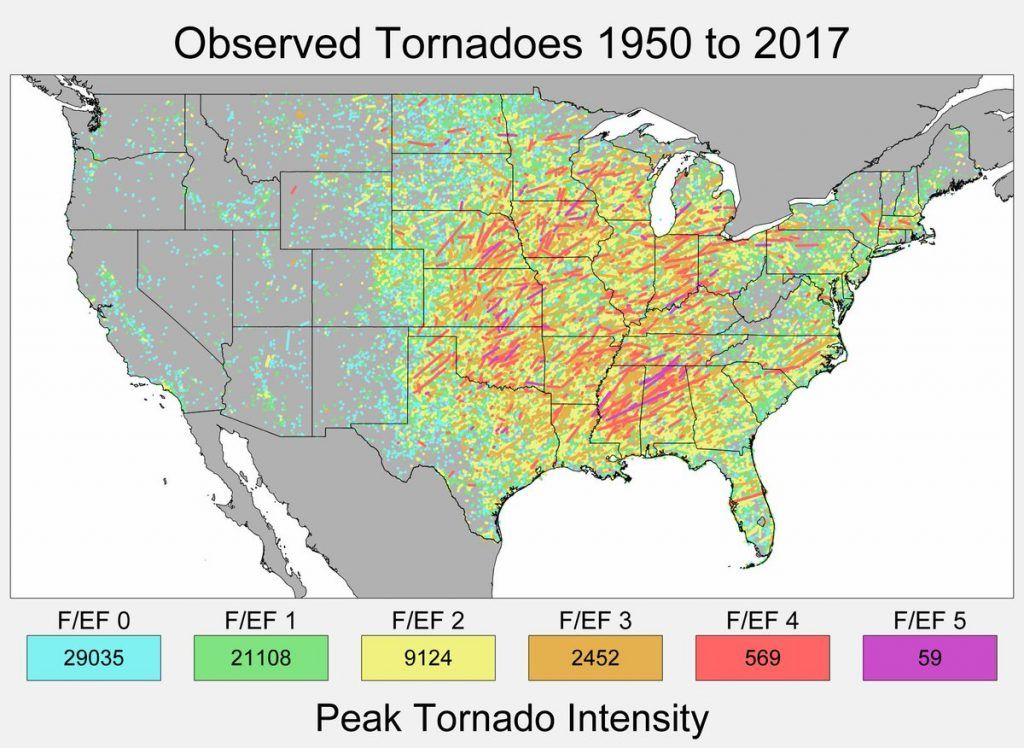
I have always just assumed that tornadoes happen more frequently in the Oklahoma area of the United States. Turns out some of the more destructive EF 5 categories have happened in the Alabama- Mississippi region
LikeLike
Evan,
I’m glad you learned something new through this post! To build off of your comment, the Dixie Alley region of our country sees some of the strongest tornado outbreaks in the United States. For example, a tornado outbreak occurred from April 25-28, 2011 in and around Tuscaloosa, Alabama. This is the costliest outbreak known so far, and 362 tornadoes were confirmed within that time frame.
LikeLike
Wow! Very informative. I too was surprised to see such a concentration of activity in Mississippi and Alabama. I did not realize there was a “Dixie Alley”. My sister lives in Arkansas so I’m concerned about the prediction for more activity in her area in the future. I will have her read your post as they do already have tornadoes in her part of the state. Very well written and easy to understand. Thank you!
LikeLike
Beth,
Thank you for your feedback, and I am glad to hear that you learned something from my post! Dixie Alley tends to see storm season before the country’s true Tornado Alley. As of now, NOAA (National Oceanic and Atmospheric Administration) states that Dixie Alley’s greatest frequency of tornado activity occurs from the months of October to December. However, the months of January – March bring a lot of tornadoes to that region as well. Speaking in terms of Arkansas, SPC (Storm Prediction Center) has verified that there is in increase in tornadic activity. In 1990, Arkansas only saw 22 tornadoes, but 2018 brought 40 tornadoes to the state.
LikeLike
That was very well done. I was surprised by your information provided about the amount of activity in Dixie Alley. When thinking of tornadoes and severe storms, my thoughts were usually guided more towards Oklahoma and the Midwest. This information provided by you game me a whole different outlook. It was very informative and educational.
LikeLike
It’s great to see you on the interwebs! I am glad you learned something new from my blog. Looking at the state of Texas, SPC (Storm Prediction Center) has 158 confirmed tornadoes for the year of 1990 and only 23 confirmed for the year of 2018! That’s shocking, especially since Texas is such a big state, it increases the probability that a tornado would form within its boundaries under the right conditions. Now, lets look at a state in Dixie Alley. Mississippi had 12 confirmed tornadoes in 1990 and 35 in 2018, which is more than Texas had. All of this is due to the eastward push, which causes the dryline to move towards the east coast as well.
LikeLike
Your article was very interesting. I really believe in climate change and it worries me all the things that are happening because of it. The weather seems to have changed so much. It concerns me that the bad weather is moving east. I hope that the mountains and the trees protect us. Your article was very informative and helps me understand whats going on and what to expect.
LikeLike
Marge,
I am glad you enjoyed my blog post. More importantly, I am ecstatic that you are aware of climate change and want to learn more! In regards to your concerns about severe weather trekking eastward, the dryline (a line that separates moist air from dry air) occurs west of the Mississippi River. Many storms form on the immediate eastern side of the dry line. Although we will see more precipitation and severe thunderstorms in Pennsylvania, we do have the advantage of topography and geological features to help dampen the “threat.”
Throughout the semester, we will be posting about the impacts of climate change on Psychology, Natural Disasters, Health, Politics/Economics, Ecosystems, and Tourism!
LikeLike
I will look forward to learning more. your explanation helps me understand things better. Look forward to your next blog.
LikeLike
I found it very interesting to learn that climate change could have an impact on natural disasters. I have personally never considered how climate change could effect our weather patterns. It seems so much more common that when we hear climate change, we consider how animals and their habitats are going to be effected. Overall, I found this view on climate change very informative as well as refreshing.
LikeLike
Meghan,
Thank you for you comment! While you are correct that climate change does indeed impact ecosystems, it honestly impacts everything else as well! Prior to receiving any education on climate, I mainly thought of climate change impact temperature, and that was about it. I never really considered all of the meteorological impacts, so I’m glad to be learning about them now, and in return, educating others! Stay tuned for content in regards to Psychology, Politics/Economics, Health, Ecosystems, and Tourism!
LikeLike
Shannon,
This was very informative and extremely interesting. It’s a topic I never really thought about and I appreciate you taking the time to open our eyes to this. I look forward to reading more from you. Keep up the good work!
LikeLike
Nicole,
Thank you for taking the time to read my blog post! I am very pleased to hear that you enjoyed it and learned something new!
LikeLike
Roughly how long do you think it will take for tornados to make it to the Eastern Region, especially Pennsylvania??
LikeLike
Missy,
There is no clear research done on when and if tornadoes will reach the east coast. Part of this matter is due to the fact that much still remains unknown about the tornadogenesis process, which definitely holds forecasting back in this manner. However, the dryline (line that separates dry air from moist air) is trekking east. As of now, it is rare for the dryline to occur east of the Mississippi River, but that can change due to this eastward movement. However, the only states that seem to be mentioned at this time are Arkansas, Missouri, Illinois, Iowa, Indiana, Louisiana, Alabama, and Mississippi. All of those state are pretty far south and/or west of us at this time. Tornadoes have occurred in Tornado Alley for decades, and we are just now seeing this eastward push more in the early 2000’s, so I believe that we will be safe for quite sometime!
LikeLike
Very well done! There is no surprise weather has been unpredictable and crazy recently! It’s awesome to see what might happen to something as destructive as tornadoes in a time of climate change.
LikeLike
Lindsey,
Thank you for your comment! Climate change certainly allows the weather to be a wild card. Part of why I really enjoy the study of meteorology is the fact that things are always changing. Therefore, it’s important to recognize patterns and what events they cause. A forecast can change in minutes. That’s why predicting on the long term is so challenging. I feel that I live a very structured life, so this element of excitement is different, and I appreciate it!
LikeLike
Nice coverage of what we do know, what factors will remain consistent (geology) and what is evolving (temps, moisture) and what those things together indicate. Looking forward to more.
LikeLike
Aunt Jenn,
Thank you for taking the time to read my post and comment! I’m glad that you enjoyed it, and I look forward to posting how climate change impacts topics other than severe weather!
LikeLike
I am very proud of the effort you have put into your passion for the weather. Most people go full steam ahead on something, then drift off in some other direction. You have stuck to what you love and plan to make it your career.
Keep up the good work.
LikeLike
Pap,
Thank you greatly for your kind words! Also, thank you for reading my blog post! I do not think there is any other major I could see myself taking up and/or being so passionate about. I love what I am studying, and I am very grateful for your support! I will be posting about how climate change impacts health, politics/economics, ecosystems, tourism, and psychology. I hope to see you back on my page soon!
LikeLike
Shannon, Wow! You just blew my mind! You are so knowledgeable about a very important subject. I can’t tell how proud I am of you.
LikeLike
Linda,
Thank you for your kind words! I’m so glad you learned some thing form my blog post, and I hope you are interest in learning about how climate change will impact other parameters on our planet as well!
LikeLike
I really enjoyed reading your blog. I am very proud of you and the knowledge you have concerning weather. I especially liked the maps showing the most severe tornado areas.
LikeLike
Grandma,
Thank you for taking the time to read my blog and leaving a thoughtful comment! Although the most recent data is from 2017, the map I included even shows the trend in the eastward shift of tornadoes. The Dixie Alley region on that graphic displays paths of quite a few violent tornadoes.
LikeLike
Shannon, I really like this post. It gave me a lot of information I didn’t know about climate change and tornadoes.
LikeLike
I think what I just was an understatement.
LikeLike
Brendan,
I’m glad you enjoyed this post and learned from it! I can’t wait to read your blogs!
LikeLike
Thanks!! I just posted mine.
LikeLike
Good job here Shannon. With natural disasters it’s also worth noting that many times even if we don’t get more tornadoes or strong tornadoes, if they start happening more at different times of years or in areas which normally don’t experience them, this also increases risk to people. Weather phenomena that you aren’t used to, are the one’s you are going to be least prepared for.
Also, while chasing has increased the frequency in which tornadoes are reported, the biggest increase came with the installation of a radar network. This has been the single biggest improvement in being able to identify dangerous storms that are rotating.
LikeLike
Dr. Gill,
Thank you for your comment and input! I completely agree with both of your statements. I know many people expressed concerns about the eastward shift through their comments. Additionally, many people are unaware of how many tornadoes occur in the SE region of our country. Chasing has definitely served as a catalyst for tornado reports. I know quite a few people are heading to the TX/OK panhandle for the marginal risk that has been forecasted for today.
LikeLike