Climate Change and National Security and Conflict

Syrian civilians run for cover after a bomb hits Eastern Ghouta in the suburbs of Damascus.

Compiled by Brendan Wissinger

For my next blog post I am going to talk about Climate Change and National Security and Conflict.  The US Department of Defense calls climate change a “threat multiplier.” This is the possibly the deadliest impact of Climate Change.  In this I will explain the current and future amplifications of this and how Climate Change amplifies war.

            Let’s again take a trip around the world, let’s first start in Norfolk Naval Base, Virginia.  Its home to the US Atlantic Fleet. But is under threat by sea level rise. Over the last 10 years the shipyard on the naval base has faced nine major floods.  The flooding is getting worse. The aftermath of Hurricane Matthew caused $1.2 million in repairs. And Hurricane Matthew didn’t directly hit the naval base.  The vital Dry Docks are at risk of being damaged.  Currently the flooding at high tide, is causing delays in ship repairs. Next let’s go to the Arctic Ocean where melting sea ice opens up the US to new vulnerabilities with its adversary, Russia.  The melting ice makes the waters more able to be navigated.  Which creates new shipping areas, which must be protected and it opens up a new front on the current second cold war with Russia.  This means the US military needs to invest in a buildup of military forces in the region.  Russia and China are already investing to exploit this new front (Dire Pedictions and Age of Consequences). Across the world in Syria, an ongoing civil war that has killed 511,000 people and displaced 12.2 million people.  The war has 4 sides, the Syrian Kurds, and Free Syrian Army, the totalitarian Syrian Government and the terrorist group ISIS.  Throughout the war different groups have moved from side to side and fought different groups.  Parts of the Free Syrian Army have allied with the Kurds to form a rebel state called Rojava who was gaining a significant foothold until a new Turkish backed Free Syrian Army started taking ground from them.  The evil terrorist group ISIS or ISIL or Daesh is fighting every other group in the war and every other group is fighting them including other Jihadist terrorist groups, and internationally many countries have intervened to help other groups quash the terrorist group territorially.  Meanwhile the totalitarian Syrian Government which does chemical warfare on its own civilians has taken back much of its territory with the aid of Russia and Iran (hrw, and rfi ). The war started after a 10 year famine, caused by drought, which has been attributed to partly being caused by Climate Change pushed the society to collapse, by destroying agriculture driving farming Syrians to cities where food prices were high and their was no employment causing citizens to rebel against its totalitarian government, setting fire to an already fragile state. Next on our places to visit is the War in Darfur, in Sudan.  This war and genocide started with a drought partly attributed to Climate Change which pushed non-Arab people of the western region of Sudan, Darfur, to their breaking point, and the revolted against the tyrannical government of Sudan, which then sent Arab militias or the Janjaweed to kill and rape civilians (as well as fighting the Non-Arab Rebels) and prevented international aid from coming to the region.  The conflict and related crisises killed hundreds of thousands and displaced 2 million people. This occurs in a region where rainfall has gone down by 30% over the past 40 years causing the Sahara desert to move into the region partly because of climate change. Other conflicts that may be influenced by Climate Change may include South Sudan Civil War, Yemen Civil War, the ISIS Invasion of Iraq and the Libyan Civil War. 

            The US Department of Defense calls Climate Change a “threat multiplier” meaning it makes conflict more likely to happen and more deadly. Though Climate Change itself doesn’t necessarily cause conflict by itself. You might ask how Climate Change amplifies wars.  It does this in several ways.  First it does this by creating a lack of resources for example water, food and fertile land or land than isn’t underwater. This can cause wars over these resources as their may not be enough resources to provide for people’s needs.  Climate Change causes drought and desertification and glacial melting leading to dwindling fertile land and less water supplies, which countries may fight over to obtain. This will exacerbated environmental refugees that I talk about coming up.  Another way Climate Change can cause wars is by stressing an already stressed society to collapse through famines, droughts, economic collapses, sea level rise. Each of these are made more likely by Climate Change which can be the final straw then can push poor countries with corrupt or totalitarian governments into chaos (Age of Consequences).  It can end liveihoods, cause people not to have their needs to survive, at which point they will fight to survive (theyearsproject).  Climate Change can cause humanitarian crises which can lead to fights for the limited resources now available as supply chains and support systems have broken down, this is made worse when people move to new regions which may aggravate already stressed populations (Age of Consequences). For example like in Syria, a drought can lead to loss of liveihoods, leading to people moving to cities where their already is a food shortage and they are unemployed, leading to Civil Unrest, a lot of desperate and angry people leads to rebellion, and sometimes terrorism. And those terrorist groups may attack us. Climate Change is not the single cause of any war, but it is part of a series of causes that causes any war (Age of Consequences).  Also global trade can be affected by Climate Change, in 2010 when Russia and China were hit be severe heatwaves devastated wheat crops, driving up the price of bread, leading to unrest in regions like Egypt as they were too poor to buy the higher prices. Another reason for instability is special circumstances for example Climate Change causing melting Arctic Sea Ice will open up new trade routes where we will be competing with Russia, securing those trade routes requires military resources to be place their when there are also other places they can be used. Another is drought in Afghanistan is causing the population to grow more drought resistant but illegal crops, poppies, which terrorists groups have used to profit off of and grow by allowing farmers to grow poppies.  Sea Level Rise, will cause people to become Environmental Refugees to be displaced and move inland where they will compete with inland populations possibly leading to tension, which may lead to conflict. And immigrant tensions rise and it will get worse as resources dwindle due to Climate Change.  The poor will not get those resources, the rich will increasing the chance for conflict (Age of Consequences). Sea Level Rise is also flooding the home of America’s Atlantic fleet in Norfolk, Virginia.  Another example is more natural disasters when natural disasters happen supply chains may break down and there may not be enough emergency supplies to give to the whole population, leading to unrest (Age of Consequences).  In addition to Sea Level Rise environmental refugees, or people forced from their homes because of environmental conditions, may be caused by drought and desertification, for example in the Sahel where environmental refugees are leaving because of drought and heading north, dangerously crossing the Sahara, and then even more dangerously crossing the Mediterranean to Europe. These people feel they have no other choice so they will do this.  Large populations with no food, water or permanent shelter, leads to instability and conflict.  And really most immigrants are refugees, as economic reasons for leaving and environmental and security reasons usually get tied up together.  As droughts and floods get worse and especially Sea Level Rise gets worse, these conflicts will get worse (Age of Consequences).  Another reason why more people may die of war because of Climate Change is hotter temperatures causes stress, causing more battles and more gunfire and more deaths. Finally Mitigating Climate Change would stop our reliance on Oil, then we would not have to have close relationships with and secure fragile states and tyrannical states for example Iraq and Saudi Arabia (Age of Consequences).

With increasing temperatures Climate Change’s deadly influence on conflict will only get worse unless we mitigate emissions immediately.  I cannot give specific numbers on how worse but I can give examples on how it will get worse.  First let’s go to the Indian Subcontinent.  This region is ripe for problems from Climate Change.  There is already tension in the region between the nuclear powers of Pakistan and India with China taking Pakistan’s side. India and Pakistan already have high tensions over water. Also India wants to free Tibet which under the control of China. Climate Change will make things worse let’s start in Bangladesh where Sea Level Rise and Cyclones is flooding farms in the south which not only hurts crops by the floods themselves but also by erosion and the salt that is brought in.  It is ruining liveihoods, and leaving farmers and their families struggling to survive, so they move north as environmental refugees to the city of Dhaka, into unsanitary decrepit slums where flooding still may be prevalent, the live in shacks, with many other people, and children may be pressed into dangerous child labor and child marriages.  By 2100, 20% of the country would be submerged at a modest 3 ft of sea level rise.  The influx of people is causing people to try to move north to India, but India is building a wall of razor wire with armed guards, who will shoot anyone who crosses the border with them and Bangladesh (The Age of Consequences).  To make matters worse, Climate Change is supposed to cause longer droughts, more variable monsoons and more intense monsoons.  So their won’t be as many rainfalls but they will be more intense.  This causes crops to either be flooded out or dried out, it causes a lack of water for people in India leading to possible conflicts over water resources needed over the longer dry period.  Also up in the Himalayas, where many people get their water from glaciers are melting and losing water meaning people are losing access to water when warmer temperatures make them need more water, leading to conflict over resources.  Combined with the current tension over Kashmir this region is a powderkeg in the future (The Age of Consequences).  Another region of concern is parts of the Middle East could be so hot and so dry they would be inhabitable. This means a lack of resources and more environmental refugees moving to wetter and cooler climates, both of these could cause a lot more war across the Middle East and North Africa.  The lack of resources caused by intense rainfall, long droughts, sea level rise and environmental refugees can also increase conflict in Sub-Sahara Africa. Most of the region relies on subsistence agriculture.  These factors could push fragile states in the region over the edge.  Drought is already affecting the Horn of Africa and the Sahel regions, increasing the likelihood for conflict in the region. Another problem is dwindling fishing supplies could lead to more conflict over fishing grounds and more piracy, this could also play out in the Horn of Africa, where piracy is already a problem. Lastly let’s go to the areas around Russia, as ice melts, Russia will gain access to oil and gas fields, below the ice, giving them more resources, another concern is that if anybody stands to benefit from Climate Change it’s Russia, as agriculture yields could increase there in a warmer climate in Russia, and mineral resources could be opened up by the melting ice.  In other ways Climate Change will adversely affect Russia, and there will be more negatives than positives for Russia. But it many stand to lose less than the US, which places Russia on a higher playing field against the United States.

The US Military is the largest buyer of oil in the world.  Each year the military acquisitions 100 million barrels to power everything from military bases to tanks to Humvees to aircraft to naval vessels. This itself makes the US military vulnerable as all of that stuff has to be imported using convoys, a big target, and the oil’s price can fluctuate wildly (then again when has the military cared about the cost of something).  Recently the US military is trying to change this, by trying to switch to mobile solar panels and wind turbines for military bases which can be used without long supply chains back to home. The Military is doing research into sun powered aircraft and hybrid-engine vehicles and tanks, meanwhile the military is experimenting and using biofuels. The US Armed Forces can’t use battery powered equipment because in a combat zone there is no infrastructure for that, so biofuels and hydrogen are the best answers for the military.  The US Armed Forces has a goal to be petroleum free by 2040.  The US Air Force has a goal to use biofuels for 50% of its within the US aviation by 2016.  By 2025, the Department of Defense says 25% of its facilities must use renewable energy.
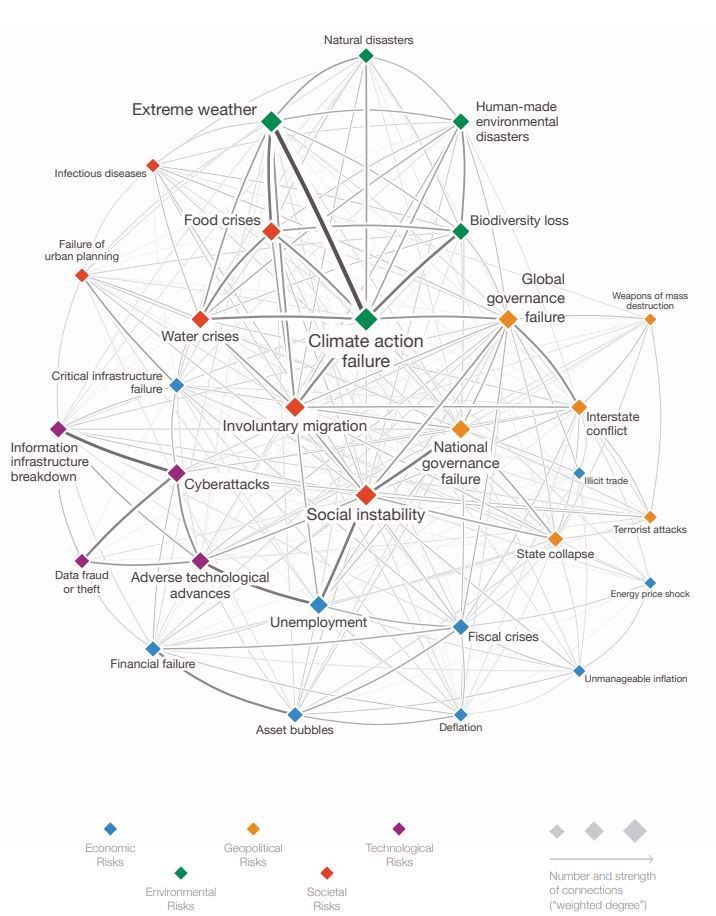
The US military has to adapt to the challenge of Climate Change.  The US military is taking measures to build seawalls, and building pumps to pump out seawater and floodwater and building buildings on higher ground to deal with hurricanes and climate change. Warmer weathers which can break down equipment and effect the days the military is training could also hurt the military and that is something else they have to adapt to.  The military will also have to beef up and make choices regarding on which countries to go to because of Climate Change being a “threat multiplier.”  The military will also have to beef up the amount of troops in the Arctic to secure shipping lanes.

How Health Epidemics Relate to Climate Change

Many people do not realize that Climate Change directly affects the spread of diseases. These diseases can be carried by humans, insects, animals, or the air. Infectious diseases kill about 4 million people each year globally and call for funding basic health services, ending vectors of disease, and bettering vaccination services and programs. Besides health emergencies from extreme weather events, climate change causes an increase in malnutrition, the spread of infectious diseases, and leads to air pollution that is linked to 7 million deaths globally per year alone.

Preparing for epidemics that could bring a devastating death toll requires nations to strengthen their focus on global preparedness. Investing in health care workers is a big one. There’s expected to be a shortage of 18 million workers by 2030. Hygiene (which shouldn’t need to be taught, people should know how to clean themselves) in all health centers should be mandatory and improved. Being able to answer medical questions should be an expectation to anyone in the healthcare field. This will build more public trust in health institutions to fight people (such as politicians) that are misinformed by how things work (such as climate change and health epidemics).

Antimicrobial Resistance (AMR) is the development by a disease-causing microbe, through mutation or gene transfer, of the ability to survive exposure to an antimicrobial agent that was previously an effective treatment. Rising global temperatures may raise antibiotic resistance as well as increase the risk of future epidemics. Dengue Fever is a good example of this. Currently dengue fever is an epidemic in over 100 countries and there’s approximately 100,000,000 cases per year. According to a study done in Latin America using a computer to investigate models of the impacts of global mean temperatures 1.5 degrees Celsius, 2 degrees Celsius, and 3.7 degrees Celsius, the increase in dengue fever would mostly affect Southern Mexico, the Caribbean islands, Northern Ecuador, Columbia, Venezuela, and the coast of Brazil. If global warming stopped at 1.5 degrees Celsius, the cases of dengue fever would drop 0.3 million cases by 2050 and 0.5 million cases by 2100. Otherwise, rising temperatures could contribute to 7.5 million more dengue fever cases per year by 2050.

GLASS was launched in October of 2015 to establish an approach to collecting, analyzing and sharing data on antimicrobial resistance worldwide. What is GLASS? GLobal Antimicrobial Resistance Surveillance System. They specifically assess drug resistance found in bacterial infections caused by Acinetobacter spp., Escherichia coli, Klebsiella pneumoniae, Neisseria gonorrhoeae, Salmonella spp., Shigella spp., Staphylococcus aureus and Streptococcus pneumoniae. It does not monitor Malaria or HIV. As of September of 2018, 52 countries have enrolled in GLASS. The most common antibiotic-resistant pathogens included E. coli, K. pneumoniae, S. aureus and S. pneumoniae, which were detected in 17 countries, followed by Salmonella spp., which was detected in 15 countries. 

Intense cyclones can result in the spread of diseases (especially waterborne diseases like Malaria). When cyclone Idai and cyclone Kenneth hit Mozambique in March of 2019 there were 50,000 confirmed cases of Malaria and 7,000 cases of Cholera reported. 603 people died in total and 1,641 people were injured. Of those 603, 8 died from Cholera and an unknown number of people died from Malaria. Climate Change is expected to cause 250,000 deaths per year from 2030-2050. The causes would likely be Malnutrition, Malaria, Diarrhea, and Heat Stress.

So now we move onto the current Epidemic right now, the Coronavirus. You may ask yourself “Self, how is the Coronavirus related to Climate Change?”. Well I’m here to tell you that all epidemics are related to Climate Change. We are an increasingly mobile global population that cannot just stay in one place. People fly to and fro whether it is for work or for pleasure without even thinking “is it safe for me to fly if I don’t feel good?”. Obviously it’s not but you do it anyway because you don’t think and just do. Humans were made to do just that, think and do. In 2018 alone there were 4.2 BILLION AIR PASSENGER JOURNEYS! One person could spread their sickness so easily to any part of the world without thinking, hence epidemics and (dare I say) hence the Coronavirus. A solution to this is not only going to take cooperation from public and private leaders but the general public as well. 

Now let’s talk about how this epidemic is going to affect Climate Change personally. Governor Wolf just asked for a statewide shutdown of all nonessential companies to shut their doors. This means restaurants, stores, specialist doctor offices, theaters, and playgrounds. President Trump has asked all Americans to not travel unless it is absolutely necessary. He has also asked us not to be in crowds bigger than 10 people. Some people have that many living in their homes. This means people are going to be confined to their homes and this is good in some aspects for Climate Change. No traveling means no airplanes running and less emissions into the atmosphere. It also means less people driving long distances like vacations or going back and forth from school. Overall, less carbon emissions by cars, planes, busses, vans, etc., is going to be the break that the environment needed. There’s no saying how long this will last but I’m sure that the Earth will enjoy its break while it lasts. 

This isn’t me saying that emissions are going to disappear because of people becoming self quarantine in their homes. They will still run electricity, air conditioning, gas, and petroleum. All of these still add to the problem of Global Warming but I’m simply just saying that we are cutting back whether we like it or not with transportation. Who knows, maybe this new way of life could last a while and we get used to it.

Thank you for reading!

Serina K. Croyle

Sources:

“Climate Change Is Making It Harder to Tackle Epidemics: Report.” Global Citizen, http://www.globalcitizen.org/en/content/climate-change-making-epidemics-worse/.

Healio. “Left Unchecked, Global Warming May Shape Future Epidemics.” Healio, 4 June 2018, http://www.healio.com/infectious-disease/emerging-diseases/news/online/{9fb0b2fb-218a-41bf-85b2-58a74d5b95e6}/left-unchecked-global-warming-may-shape-future-epidemics.

O’Reilly, Eileen Drage. “Epidemics, Socioeconomic Inequalities and Climate Change Are This Decade’s Global Challenges, per WHO.” Axios, 20 Jan. 2020, http://www.axios.com/who-emerging-health-challenges-pandemic-climate-change-inequalities-f83e0dd1-6d00-40c4-aaca-11523270648c.html.

Vaughan, Adam. “How Deadly Disease Outbreaks Could Worsen as the Climate Changes.” New Scientist, 15 Oct. 2019, http://www.newscientist.com/article/2219981-how-deadly-disease-outbreaks-could-worsen-as-the-climate-changes/.

Zhang, Jennifer, et al. “Coronavirus Response Shows the World Is Not Ready for Climate-Induced Pandemics.” State of the Planet, 1 Apr. 2020, blogs.ei.columbia.edu/2020/02/24/coronavirus-climate-induced-pandemics/.

Increase in Crime Rates from Climate Change

The link between crime and climate has drawn attention to the field of criminology and sociology since the mid-19th century. With temperatures quickly rising, we could see an increase of two to three million more violent crimes between now and the end of the century. With studies being conducted that show the link between warming temperatures and an increase in crime, there is one likely explanation; warmer temps lead to more people being out and about, which creates more opportunity for crime. 

The Temperature- Aggression Hypothesis

The temperature- aggression hypothesis basically states that people exposed to psychological heat stress are more likely to see personal interactions as aggressive rather than ordinary conversations; we all know how cranky some people can get when they are out on a hot, humid summer day. This can result in someone getting angry over a situation they would not typically be angry about. The biggest increases in crime were rape, sexual assault, violence involving a weapon, and violence resaulting in serious injury. The temperature- aggression hypothesis will describe an increase in violent crimes, but not necessarily property damage, or robberies. Although, property damage and robberies will still increase due to the fact that more people will be outside and around other people’s property. Property damage and robberies can be driven by the “Routine Activities Theory”, which states that crime doesn’t typically happen in isolation, and is driven by opportunity. Heat creates opportunity for more people to be on the streets, and be negatively influenced.  

The Trends

Research pulled from the FBI crime database and NOAA climate data shows the correlations becoming more relevant in warmer winters. The crimes that have shown the biggest spike include assaults and robberies. 

(Figure 1: Courtesy of IOP Science)

On the graph above, you can see the general rising trend of the amount of violent crimes committed per month that correlate with the increase in temperature. From 1.5 degrees celsius, you see a little less than 1,000 violent crimes being committed per month, while at a 4 degree celsius rise in temperature, you see 3,000-5,000 violent crimes being committed per month. Much research is being done to predict the projected increase in crime at certain temperatures. This could be a good way to bring attention to the public about climate change, because crime will directly affect the population in a more immediate way than climate change alone. 

Overall, as long as temperatures continue to increase, so will crime. The only way we can reduce climate-induced crime is to reduce our greenhouse gas emissions and improve our climate conditions. I see bringing climate-induced crime to the public eye as a good way to educate people on the more immediate effects of climate change, most people turn a blind eye to the situation because they assume it will not affect them in their lifetime. Let’s start now.

-Kaila Teets

How Hurricanes Will Be Affected by Climate Change

Hurricanes are driven by a thing called “Thermodynamic Disequilibrium”. In order to attain “Thermodynamic Equilibrium” , three different types of equilibrium must happen; 1.) Thermal Equilibrium 2.) Mechanical Equilibrium and 3.) Chemical Equilibrium. 

Thermal Equilibrium is when the system does not change with time and has the same value in all locations of the system. This means that the temperature does not change anywhere in the system of the storm. Hurricanes have a gradient in temperature from the outer bands to the eye from warm to cold.

Mechanical Equilibrium is when the geostrophic winds are in balance within and around the system. This means that the Pressure Gradient Force (PGF), Coriolis Force, and Frictional Force are all in balance. Since we’re talking about a system that is located in the upper atmosphere, friction does not exist. Hurricanes have different forced winds in every location of the system therefore this part would not make any sense.

Finally, there is the Chemical Equilibrium. This is when there is no chemical reaction present in the system and every location in the system has the same chemical composition. Between the many different unstable forms within a hurricane, there’s no way for the atmospheric chemicals to be in balance.

This Disequilibrium drives a strong flow of heat from the ocean to the atmosphere. This is a direct consequence from the Greenhouse Effect. To explain the Greenhouse Effect, it is simply the rise in global temperatures caused by the pollutants in the the air like carbon dioxide, methane, and chlorofluorocarbons. It tends to focus its effects on the regions where it was created. Carbon Dioxide (CO2) is the biggest contributor to the Greenhouse Effect and is the largest presence of any human-produced Greenhouse Gas. Tiny island nations are the most vulnerable to these gases because of Sea Level Rise.

Some examples of how Climate Change effects hurricanes are Katrina and Sandy. Both of these systems were present during a strong El Nino season. 

 Hurricane Katrina made landfall in Louisiana as a category 3 and caused storm surges as high as 27 feet tall. She was the third largest hurricane to make landfall in the United States and caused an estimated $14 billion in damage. 1,200+ people lost their lives to this storm and caused 80% of New Orleans to be submerged in water. Some news companies went as far to say that Hurricane Katrina should have been nicknamed “Climate Change Herself” because of the pure  shock and devastation that she brought to New Orleans.

Superstorm Sandy was another devastating storm. She was a Category 1 when she made landfall in the Caribbean and Haiti but then when heading up the East coast of the United States, lost her intensity and made landfall in New Jersey and New York as a tropical storm with sustained wind speeds of 70mph. Only 149 deaths were caused by this system (most from the Caribbean and Haiti).

The Terrible Trio of 2005

Hurricane Katrina was part of something called the “Trio of 2005” which involved 3 different systems that were devastating and dangerous to the United States and surrounding islands. The other two hurricanes involved were Wilma and Rita. 

Katrina and Rita both reached a category 5 by passing over a patch in the central Gulf of Mexico heated by an infusion of deep, warm water from the Caribbean. This is caused by the Loop Current. By the time they made landfall, both were a category 3.

Wilma intensified from a category 1 to the lowest barometric pressure recorded within a 12 hour period of 882 hectopascals. 

The Triple Whammy: Harvey, Irma, and Maria

Hurricane Harvey made landfall in Texas as a category 1 on August 25th, 2017. 30,000 people living in Texas fled to temporary shelters before and stayed after the storm until their houses could be rebuilt (if that was even possible).  The death toll was 88 people, all being people that did not decide to evacuate from the coast. In total over 50 inches of rain was reported and the storm caused approximately $125 billion in damage.

Hurricane Irma first made landfall as a category 4 on the islands of Antigua and Barbuda leaving it barely habitable. Next it moved onto Puerto Rico, Haiti,Dominican Republic, Caicos islands, and the Bahamas (also as a category 4) with over 15 inches of rain and severe flooding. When Irma downgraded to a category 3, she affected the North-East of Cuba and Havana with waves up to 36 feet high. Upgrading again to a category 4 she hit the Florida Keys with 12 inches of rain and Miami reached a state of emergency.

Hurricane Maria was developed less than two weeks later and intensified all the way to a category 5 with sustained winds of 175mph. The Dominican Republic and Puerto Rico were the worst affected. This led to Puerto Rico asking neighboring countries for $94 billion to cover the damages. The United States made a donation of $24 million.

Will there be more cyclones in the future?

Peter Webster (Georgia Institute of Technology) led a team ranking cyclones since the 1970s to find a pattern in intensity. He discovered that the strongest cyclones were nearly 50% more frequent globally from 1990-2004 than they were from 1975-1989. From his work, we can see that sea surface temperatures in the North Atlantic alternated every 30-40 years from warming to cooling. He came to the conclusion that tropical cyclones might get larger over time in some areas but results varied by region.

Sources:

“Global Warming and Hurricanes.” GFDL, http://www.gfdl.noaa.gov/global-warming-and-hurricanes/.

Leslie, Jacques, et al. “Atlantic Hurricanes Are Becoming Stronger Faster, Largely Due to Climate Change.” Yale E360, 8 Feb. 2019, e360.yale.edu/digest/atlantic-hurricanes-are-becoming-stronger-faster-largely-due-to-climate-change.

Climate Change and Agriculture

 Global agriculture is inextricably linked with the Earth’s climate. Minute changes in climate could have a significant effect on local agricultures around the world. Climate changes is in some aspects, like local moisture levels, causing a polarization of climate, in the sense that climate is getting pushed towards one of two ends of a spectrum: either severe drought of frequent flooding. Trends show a feedback response where wet places are getting wetter and drier places are getting drier. There are, of course always exceptions to the rules, but these are somewhat few and far between. These changes could end up causing chain reactions and thus having major impacts on agriculture across the globe.

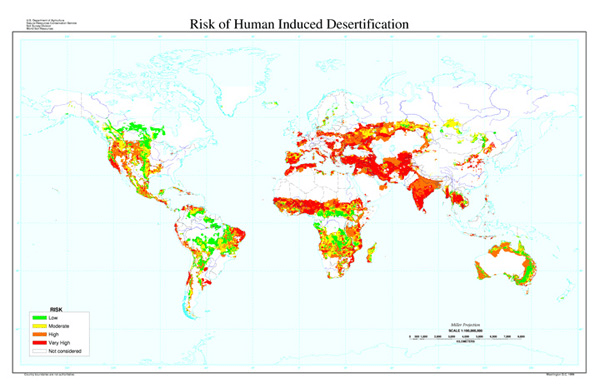
Drought is the more commonly thought of effect of climate change on regions of agricultural use. Drought is defined as a prolonged period of time where there is not sufficient levels of precipitation or moisture. As we all know, plants are dependent of having sufficient amounts of water. Without it, the existing crops would dry up and die, and new seeds may never even sprout in the first place. This would create food shortages in many drier regions of the world and will cut production across many high production areas, like California. This shortage of both farmed plants, as well as wild plants, would have a severe effect of grazing lands. Many places not particularly well suited to growing plants, like the steppes of central Asia or southern Argentina, maintain agricultural industries by grazing large numbers of cows and other livestock. Lack of food and water could decimate the populations of farm animals in these regions. These droughts themselves would likely be long term, which would cause desertification to occur in these areas.

Figure 1: A map of areas at risk for desertification. Courtesy of USDA

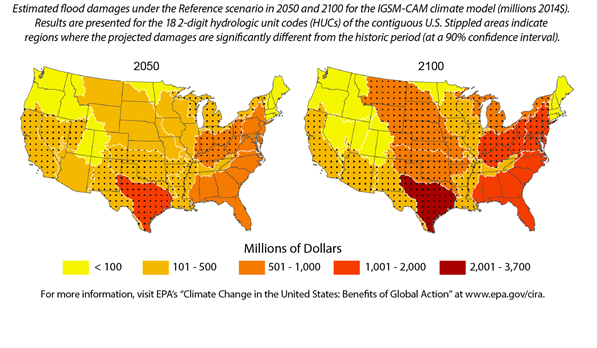
On the other hand, we have flooding events. Flooding events create a whole different set of issues for agriculture, albeit with a similar end result. Excessive amounts of water running through water bodies will cause flooding. The flood waters themselves will often choke out drops that are trying to grow in those areas, in addition to drowning the livestock that gets left behind and are unable to escape the quickly rising waters. Even after the water recedes, however, it will still kill of crops. The soil will retain lot of the water, and that creates a breeding ground for plant pathogens, like viruses, bacteria, and fungi. Plus, the water in the ground will greatly increase the odds of plants rotting of en masse following these flooding events. The end result is a shortage of crops, and lower numbers of livestock.

Figure 2: Map of flood damage to the US in the future. Courtesy of the EPA

These mass failures in agriculture will have profound effects on human society as well, which will be worsened by it creating its own feedback loop. Shortage of crops and agricultural products would cause more famines, particularly in already stressed regions, as well as exacerbate existing famines around the world. These famines would like cause large amounts of civil unrest in areas hard hit by the crop failures. The civil unrest will itself worsen the ability for food to be distributed to mitigate the famine. These factors will cause large scale migrations of people to neighboring regions. The influx of these people will put additional strain on areas that may have only just been getting by with the resources available to them. This will most likely result in a large-scale crisis over the long term, which will subsequently require large scale intervention from the international community to effectively combat these issues.

I feel the need to address the counterpoint often given: won’t the melting ice and permafrost open up new ground for farming and agriculture in more northern or southern locations? The short answer is sort of, but not really. Land that has been under ice will have lost most of its topsoil and nutrients to the movement of the ice over time, and thus you would be trying to farm or graze on nothing but gravel in these areas. Some areas opened up by permafrost will be able to be farmed on a small scale, but soil there is still pretty poor and the unevenness of the terrain would make it difficult to do any large-scale farming in these locations. It would not be able to offset the losses occurred in other areas due to drought, flooding, fires, and other climate stresses.

To sum up, the climate will have significant impacts on global agriculture. No matter what the change is, it will, in most cases, cause significant detrimental effects on local agriculture across large swathes of the world. Human society will be strained in the areas most strongly affected by the changes. There will be significant secondary repercussions if the climate change is allowed to run rampant and cause these declines in agriculture. These declines will not be offset by any land gained from thawing.  

Image Sources:

Figure 1: https://www.nrcs.usda.gov/wps/portal/nrcs/detail/soils/use/worldsoils/?cid=nrcs142p2_054004

Figure 2: https://www.epa.gov/cira/climate-action-benefits-inland-flooding

Climate Change and Droughts

Compiled by Brendan Wissinger

            For my second topic I will be talking about climate change and droughts. Droughts are alarming because communities can run low or even run out of water, and crops can die from droughts and water is needed for many different power plants for example nuclear and hydropower and this may cut off electricity and combined with the heatwaves that usually go alone with droughts this can lead to deadly consequences.

            Again the climate change driven droughts are happening now, and they are a current concern. Let’s take a trip around the world again to see these impacts first stop is California.  Between 2012 and 2014, climate change intensified a drought in California by 15 to 20%.  This was projected to cost the economy of California $2.7 billion per year.  The drought caused crops to die and injured livelihoods. Much of the fruits and vegetables in the US come from California. Attribution studies have also linked this heatwave to Climate Change. Another area where droughts have been persistent is Australia. In Communities Australia people are leaving as they lose jobs from the drought and the communities are becoming poorer and smaller ghosts of themselves and they have to sell their livestock and move away.  Much of Eastern Australia has been having drier than normal conditions since 2013 (with the exception of 2016) until at least 2018.  The droughts have been the worst in western Queensland.  Droughts have gotten worse through 2018.  The hot weather can kill crops and drier soils can also kill crops or decrease yields.  The soil has been the driest its been in 105 years in many areas of New South Wales. This also is partly attributed to Climate Change.  This drought caused large wildfires in Australia.  Our next stop on our tour of misery is East Africa.  The droughts in the poor areas of the Horn of Africa have been the worst in 60 years in large areas of Somalia, Ethiopia, Djibouti and Kenya.  Over 11 million people are affected were affected between 2011 and 2012, leading to large scale famine.  Again in 2017 drought has occurred again and it is still ongoing.  More than 12 million people are going starving.  Eighty percent of the population relies on subsistence farming where they only can make enough food to feed themselves and their families and the drought they destroys their crops leaves them with little options.   Currently these areas are facing a swarms of locusts.  When rain does occur it comes in downpours that also destroys crops. Many are leaving these countries as environmental refugees living in refugees camps in areas on the outskirts of this crisis for example Kenya. This drought has also been partly attributed to climate change.  Another area where droughts are of concern is Syria. The drought in Syria which lasted about 15 years, was the worst in 900 years! Because of the drought there was a failure in 75% of Syria’s farms and 85% of livestock died between 2006 and 2011. This failure of agriculture, caused over 1.5 million Syrian internal environmental refugees which moved to cities which could not or would not accommodate them, leaving them hungry, homeless and angry.  This situation helped catalyze the uprising to the dictator of Syria that caused the Syrian Civil War which killed around 511,000 people and displaced 12.2 million people.  This drought has also attributed to Climate Change.  The Last Place on our tour is South Africa where drought has been getting worse from 2018 onward and a major city in South Africa almost ran out of water. The southern Africa, droughts have led to food shortages affecting 45 million people.  To make matters worse this past year the droughts were interluded by cyclones. Countries affected include Democratic Republic of the Congo, Malawi, Mozambique, Tanzaina, Zambia, Zimbabwe and South Africa.  Worse affected were the countries of Zambia and Zimbabwe.  Grain production has decreased by 30 percent and Zimbabwe is running out of corn. Livestock has suffered loses from starvations. Here, drought has been a problem for several years. Cape Town, South Africa was close to running out of water, and having to have the water system shut off. Other impacts include California having the driest year on record in 2013, and in 2011 Texas had its driest year.

The Impacts of droughts can be economic, or human costs, indirect or direct.  Droughts impact agriculture and kill crops for example corn, soybeans and wheat from not enough water.  Also heatwaves that usually go with droughts can kill crops because of the heat.  The lack of water can lead to dehydration or starvation of livestock and the heat can also kill livestock. This may cause a farmer to lose much of their yearly income and if their a subsistence farmer who only makes enough normally just to live off of, it can be deadly. Also droughts may increase the funds needed for water and feed for animals and irrigation. This all leads to higher food prices and in extreme cases famine.  Droughts can also affect transportation on major canals and rivers by decreasing water levels.  Also heatwaves that go with droughts can buckle roadways, and rail infrastructure.  Droughts also allow wildfires to spread, and coupled with the heat goes with them can make a deadly mix. Millions of acres and thousands of homes have been lost because of fires in the past decade.  Wildfires are expected to be six times larger in 20 years.  Droughts can decrease the water getting to steam turbines used in nuclear and coal fired power plants, and decrease water used for cooling in Nuclear power plants, and decreased water levels are problematic for hydropower plants. And when droughts and heatwaves go together more people are using their air conditioning complicating matters.  Also the heatwaves that usually coincide with droughts can kills hundreds or thousands, sometimes tens of thousands (like the 2003 European Heatwave killed 70,000 people) of people.  Droughts can lead to an increase in disease in wild animals with less supplies for food and water which itself is problematic.  Droughts can also destroy habitats for example forests, through forest fires, wetlands, and ponds through evaporation and drainage.  The heatwaves that coincide with droughts can exacerbate air pollution leading to deaths from that.  Also droughts and famines often can lead to societal stress that causes wars and conflict. For example the Syrian Civil War was preceded by a long drought that led to shortages of food and loss of livelihoods which was part of catalyst for the war which has killed over 500,000 people. The US Department of Defense has named Climate Change a “threat multiplier” for this reason.  As people lose their livelihoods or cannot get food, societies are pushed to collapse, leading to wars, terrorism and refugees.  Also wars over resources for example food and water will likely increase in the future.   Also long lasting droughts can displace persons leading to environmental refugees, and causing mass migrations.

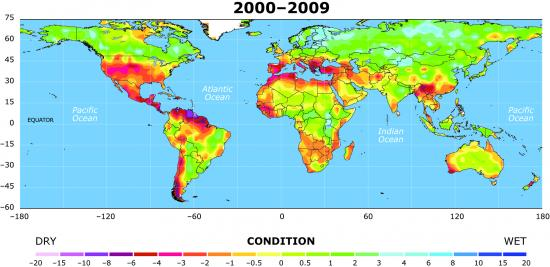
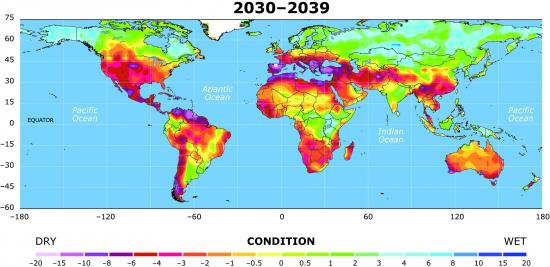
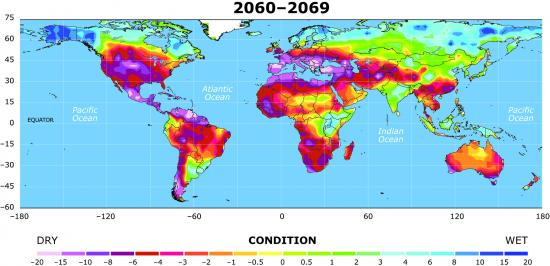
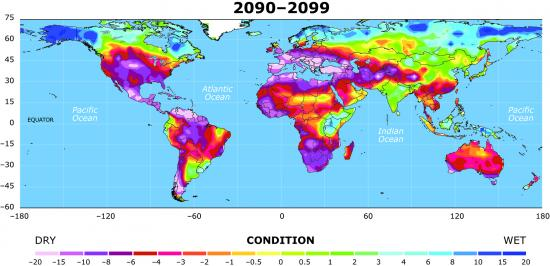
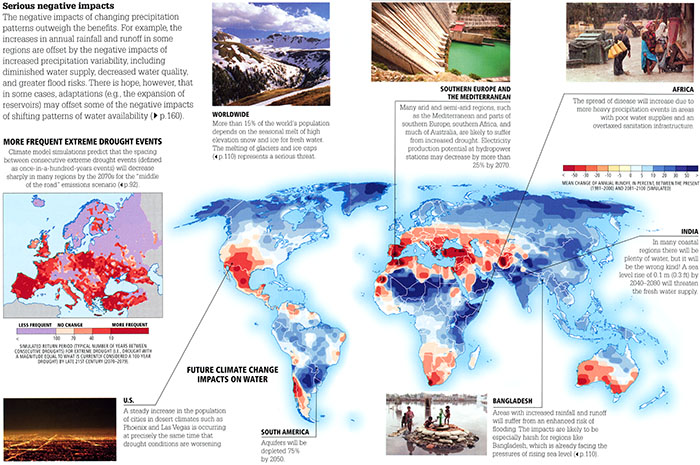
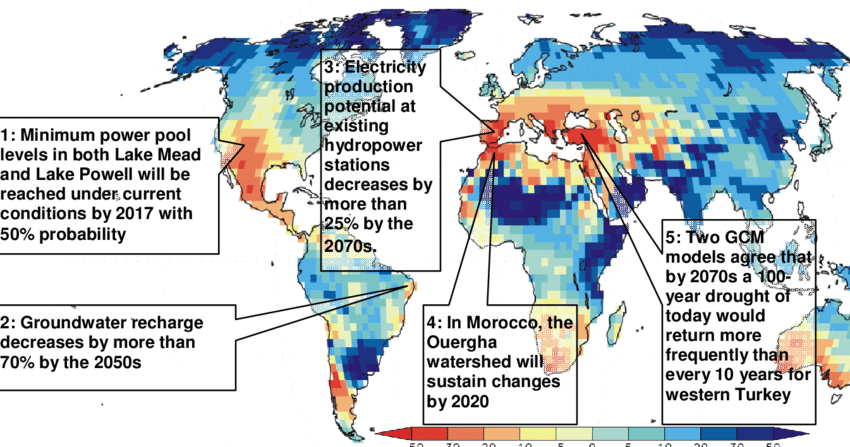
Projections of Climate Change suggest that warming will cause droughts to get hotter and longer, and rain to happen less often but when it does come it will come in severe downpours, flooding areas. In general drier areas on Earth are expected to get drier and wetter areas are expected to get wetter.  Its expected to get a lot worse in the future.  At current rates of emissions and warming we could see droughts lasting on and off for decades in the Southwestern US, meaning the entire climate there would change to be drier. Again the countries that will be worst affected will be developing countries, especially African countries.  In areas fed by glaciers, the melting of glaciers from climate change can leave areas without water, this is especially important in India, Pakistan and Nepal and Tibet and surrounding areas, leading to shortages of food from drought. Many regions are entering droughts that are almost consistent, leading scientists to question if they are the new normal. Below are some projections of droughts and floods around the world.

Actually there are several different times of droughts that lead from one to the next and not all droughts go through each type.  First there is a meteorological drought or a drought relating to weather where there is little or no precipitation. Second there is hydrological drought when there is a low water supply in rivers and in groundwater which occurs after many months of meteorological drought.  After a hydrological drought there is an agricultural drought which is when yields drop or crops fail due to a lack of water.  Lastly there is a socioeconomic drought when water to communities and food and other products like energy are not able to be bought or sold because of the drought.  Usually a hydrological drought will take a long time to be fixed unlike a meteorological drought. Also there are many causes to a drought 1) there is a drought related to high temperatures, which is when heatwaves move through they require agriculture and communities to use more water to hydrate humans and crops and cool machinery and animals so the demand increases, 2) the weather causes droughts either from high pressure systems lasting for long times or climatic oscillations like El Nino and La Nina, 3) as a drought continues or as soil moisture goes down there is less water to cause precipitation, so this is a positive feedback loop on droughts, but usually weather doesn’t stay in one location and moves and usually where the majority of evaporation occurs is not the same place precipitation occurs, 4) Higher demand for water can cause drought, for example Lake Mead which supplies water for Arizona, Nevada, and California is decreasing in size not just due to a 19 year drought, its also due to rising demand for the water.  So this means that usually drought is connected to meteorological factors but not always.  5) The timing of when the water comes doesn’t coincide with the agricultural season leading to water shortages and crops not able to be grow.  It may also be hard to tell when a drought is coming because they are slowly happening.  Also climate change causing intense downpours really doesn’t help alleviate the drought it creates because usually intense rains run right into rivers and streams and back out to sea, and the ground gets overly saturated, and excess is washed away and the soil dries up after a while, while a slower more steady rainfall would allow more water to be soaked up by the soil.

To adapt to these droughts and heatwaves we can implement better water capture and storage systems, increasing energy efficiency in buildings, increasing the ability to store food, increasing international aid to developing countries, using genetic engineering to create drought resistant crops.  We can also create more water efficient appliances and housing and regulate and limit water use for non-essential things. We can use alternative water supplies, desalination, limit water use when water is scarce, reduce water pressure in water pipes and use public relation campaigns to push for less water use.  We can also change water rights laws so people who have the most rights are not the people who get their first or pay the most, but the people who need the most for the most essential activities.

            Next week: War and Conflict.

Mann, Michael et al. Dire Predictions. https://www.nytimes.com/2014/03/17/us/wests-drought-and-growth-intensify-conflict-over-water-rights.html https://earthobservatory.nasa.gov/images/51411/severe-drought-causes-famine-in-east-africa https://www.thenewhumanitarian.org/feature/2017/03/17/drought-africa-2017

https://www.un.org/africarenewal/web-features/famine-somalia

https://www.actionaid.org.uk/about-us/what-we-do/emergencies-disasters-humanitarian-response/east-africa-crisis-facts-and-figures https://www.smithsonianmag.com/innovation/is-a-lack-of-water-to-blame-for-the-conflict-in-syria-72513729/ https://www.nytimes.com/2015/03/03/science/earth/study-links-syria-conflict-to-drought-caused-by-climate-change.htmlhttps://www.vice.com/en_us/article/3kw77v/the-drought-that-preceded-syrias-civil-war-was-likely-the-worst-in-900-yearshttps://www.theguardian.com/environment/2016/mar/02/syrias-drought-has-likely-been-its-worst-in-900-yearshttps://www.hrw.org/world-report/2019/country-chapters/syria https://earthobservatory.nasa.gov/images/146015/drought-threatens-millions-in-southern-africa https://www.weforum.org/agenda/2019/08/cape-town-was-90-days-away-from-running-out-of-water-heres-how-it-averted-the-crisis/ https://www.forbes.com/sites/kensilverstein/2019/11/07/for-southern-africa-climate-change-is-real-as-prolonged-droughts-are-creating-food-shortages/#73e4e8ef43f7 https://www.globalcitizen.org/en/content/southern-africa-drought-water-climate-change/https://climate.nasa.gov/news/2881/earths-freshwater-future-extremes-of-flood-and-drought/https://www.nytimes.com/2018/12/12/climate/climate-change-floods-droughts.html https://www.forbes.com/sites/lauratenenbaum/2019/10/15/climate-change-impacts-monsoon-flooding-in-india/#3765a98d4550 https://www.c2es.org/content/drought-and-climate-change/https://www.reuters.com/article/us-asia-water-glaciers/melting-glaciers-threaten-asias-drought-buffer-scientists-warn-idUSKCN1SZ2AG https://www.ucsusa.org/resources/drought-and-climate-change

https://eos.org/features/how-will-climate-change-affect-the-united-states-in-decades-to-come https://www.slashgear.com/nasa-drought-study-human-climate-change-impact-research-02575363/https://www.cnn.com/2019/05/01/health/drought-human-caused-scn/index.html

http://www.climatechange-foodsecurity.org/drought.html

http://www.cgd.ucar.edu/cas/adai/news/Dai_Drought_UCAR.htm

https://www.eea.europa.eu/data-and-maps/figures/projected-impacts-of-climate-change

https://www.researchgate.net/figure/Illustrative-map-of-future-climate-change-impacts-on-freshwater-Adapted-from-Kundzewicz_fig7_264889492

https://www.ncdc.noaa.gov/monitoring-references/dyk/drought-definition https://jainsusa.com/blog/drought/ https://www.bbc.com/news/science-environment-50602971 https://www.vox.com/2016/5/23/11736340/lake-mead-water-drought-southwest https://www.nytimes.com/2019/03/19/climate/colorado-river-water.html

https://www.carbonbrief.org/guest-post-climate-change-is-already-making-droughts-worse https://www.bbc.com/news/world-africa-13944550 http://www.bom.gov.au/climate/updates/articles/a010-southern-rainfall-decline.shtml https://www.theguardian.com/environment/ng-interactive/2018/oct/03/the-new-normal-how-climate-change-is-making-droughts-worse https://oxfamblogs.org/fp2p/is-climate-change-to-blame-for-the-east-african-drought/ https://www.c2es.org/content/drought-and-climate-change/ https://drought.unl.edu/Education/DroughtforKids/DroughtEffects.aspx

https://www.carbonbrief.org/droughts-and-heatwaves-cause-10-drop-in-annual-crop-harvests https://www.outsideonline.com/2289216/20-years-wildfires-will-be-six-times-larger https://www.carbonbrief.org/daily-brief/climate-change-intensifies-california-drought-scientists-say https://www.nytimes.com/2015/08/21/science/climate-change-intensifies-california-drought-scientists-say.html?auth=login-google&emc=rss&partner=rss&utm_campaign=65eb9fd7f9-cb_daily&utm_medium=email&utm_source=Daily%20Carbon%20Briefing&utm_term=0_876aab4fd7-65eb9fd7f9-303449629

https://insideclimatenews.org/news/31102018/jet-stream-climate-change-study-extreme-weather-arctic-amplification-temperature

https://www.dw.com/en/drought-crisis-in-the-horn-of-africa/a-38950292 https://www.aljazeera.com/indepth/inpictures/horn-africa-millions-suffering-due-prolonged-drought-190318055110862.html https://www.forbes.com/sites/dennismersereau/2018/06/19/how-can-drought-set-after-so-much-heavy-rain-its-easier-than-you-think/#1e92ed6061d5

Health: The Migration of Mosquitoes in North America

One of the most immense concerns related to climate change is how this matter will impact the health of Earth’s general population. Many factors lead into the role climate change has within the medical field and each individual’s well being. Air quality can slump, allergies can become significantly more aggravating, new diseases can arise, etc. The best way we can serve ourselves is to become aware of the changes our planet is facing, educate ourselves and others, and learn how to take the proper precautions to prevent our health from declining. Climate change is predicted to serve as a catalyst for vector-borne illness to become more of a risk to humankind. With this being said, mosquito evolution is on the upward trend with increasing temperatures and precipitation, and in return, will enable more mosquito-borne diseases. Therefore, throughout this post, I will examine and explain the evolution of mosquitoes in relation to climate, mosquito-borne diseases, and precautions we should be taking.

Our Planet’s Diverse Climate

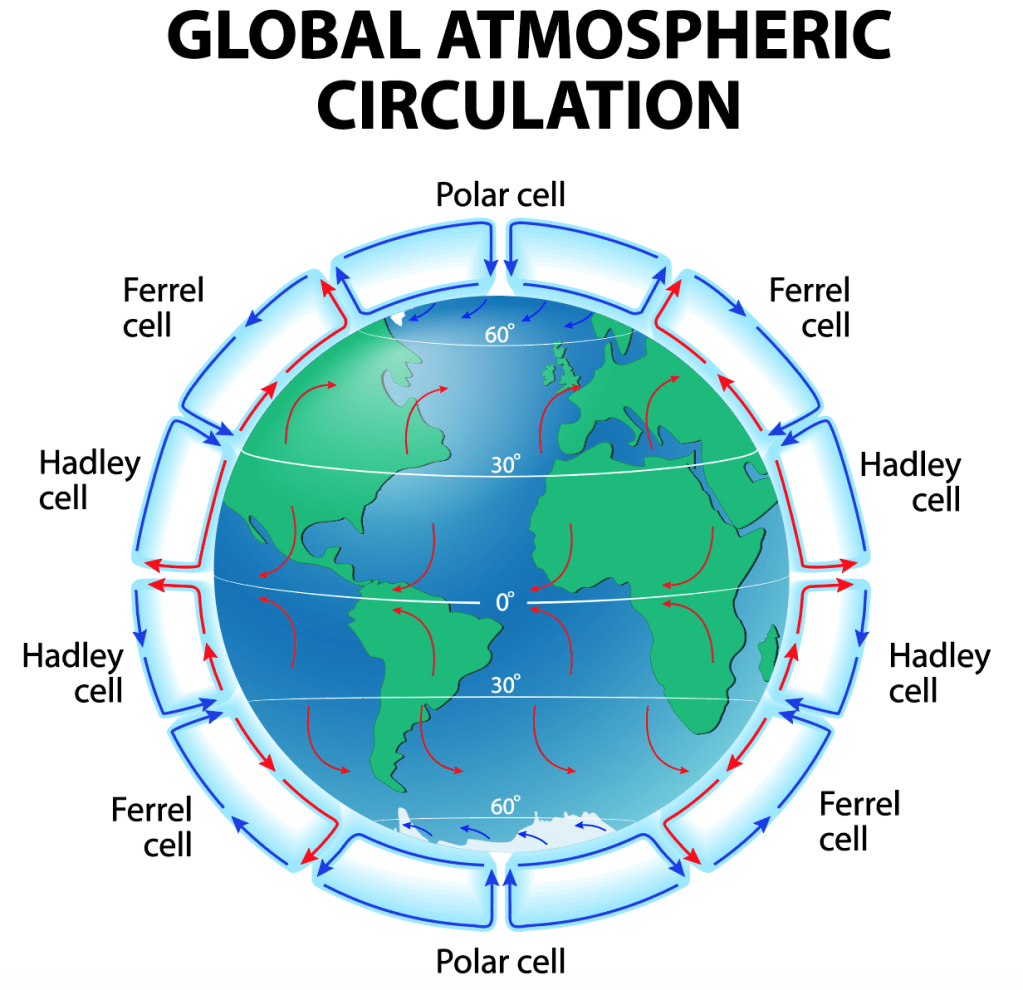
Have you ever wondered how it is even possible for climate to vary so much within a single country or continent? The way our climate is distributed and regulated across the planet is a result of global circulation patterns that vary greatly with latitude. Three different cells contribute to Earth’s diverse climate. The Hadley Cell, the Ferrel Cell, and the Polar Cell work as a system to balance heat and energy throughout our planet (click here to learn more about each cell). For example, a high pressure system (associated with dry weather and a clear sky) that acts on Earth’s surface is balanced by a low pressure system (associated with cloud formation and precipitation) that is occurring elsewhere. As a result, our planet’s regions are unique due to their exposure to different weather patterns. This concept provides reasoning behind why Columbia receives an average of 3,240 mm of precipitation on an annual basis, and the Sahara Desert only receives up to 101 mm of rain per year. With all of this being said, the key idea is latitude. Specifically speaking in terms of North America, its lands span a lot more latitude than Europe and Australia. As a result, the climate throughout North America will be more diverse within itself than it would in Europe or Australia. 

Figure 1. Digram demonstrating where all three cells are located globally.

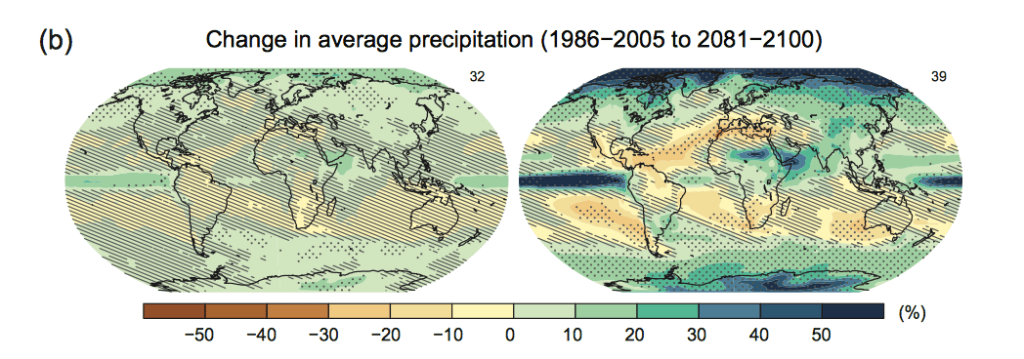
With greenhouse gas emissions on the rise, current models display the trend that dry regions will only become more water stricken, and wet regions will receive more precipitation. This pattern is showcased by Figure 2. Higher greenhouse gas emissions are creating a larger margin between wet and dry climates, making them almost seem extreme. Looking at Figure 2b, it can be concluded that the United States will see more precipitation with the exception of states such as Texas, New Mexico, Arizona, and regions of a few of their bordering states. Mexico also faces drier conditions. Mexico also faces drier conditions.

Both of these conditions bring on their own risks that will interfere with society and the environment. Hence why every continent is home to diseases, vectors, and conditions that are only specific to their region. Areas that are prone to dry conditions will experience consequences related to water shortages and national security. On the other hand, wet regions are prone to flooding, poor water sanitation, and more infectious diseases. Many of which can be caused by mosquitoes.

Figure 2. Displays precipitation distribution for our planet with low greenhouse gas emissions (LEFT) and precipitation patterns for our planet with high greenhouse gas emissions (RIGHT).

Mosquito Forecast

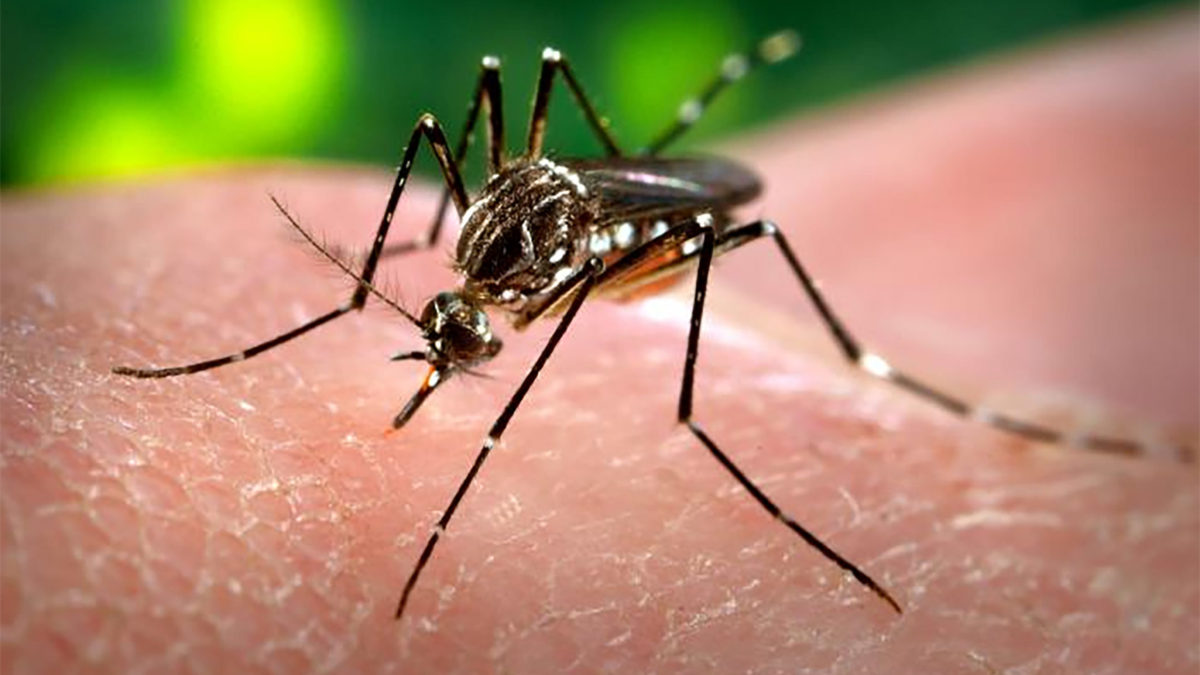
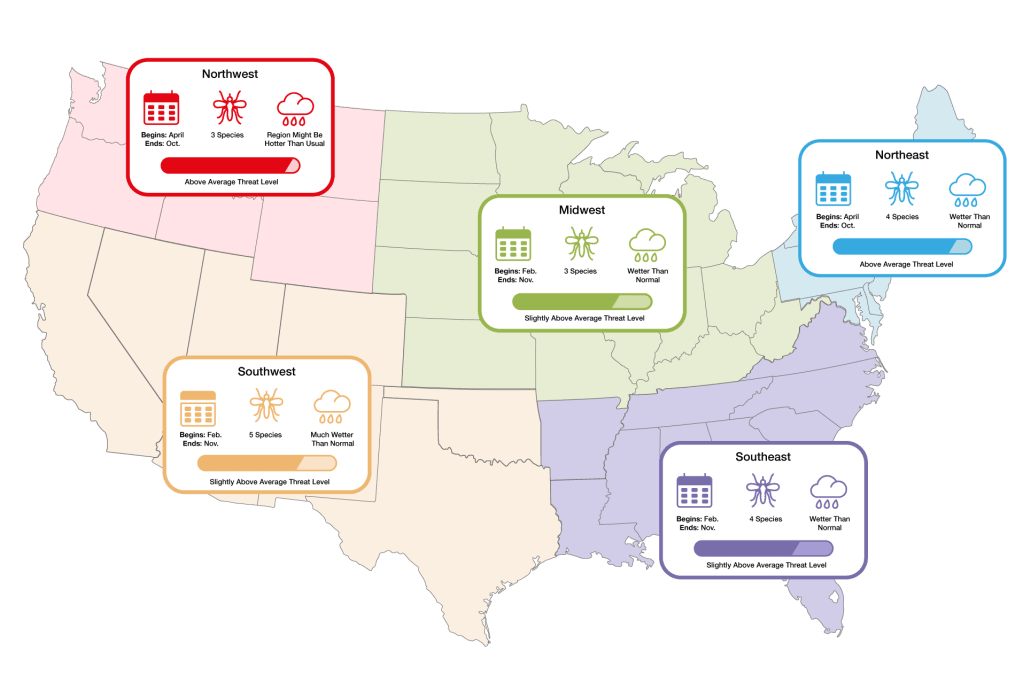
As mentioned above, mosquitoes are attracted to an environment that is warm and receives a sufficient amount of moisture. They are most active in warm temperatures, however, a cold front that follows warm weather can trigger these insects to increase their biting activity, as they are attracted to the carbon dioxide we emit. With temperatures trending warmer, mosquitoes are now able to migrate farther north to environments that would have once been inhospitable to them. At this time, researchers are investigating how far north these insects will travel. Female mosquitoes deposit their eggs in water, and they tend to look for bodies of water that do not contain fish. Mud puddles in your backyard, streams and creeks, and ponds are all areas that satisfy mosquito reproduction requirements. With the majority of North America being on the upward trend in regards to precipitation due to human-induced climate change, we can expect to see more mosquitoes. As of now, there are 7 known types of mosquitoes that reside in North America, and they are as follows: northern mosquito, western encephalitis mosquito, eastern tree hole mosquito, yellow fever mosquito, asian tiger mosquito, northern house mosquito, and southern mosquito. With each region of the country having their own distinct weather patterns, some mosquitoes are found in only a few corners of our country, where others are found almost anywhere. Figure 3 shows a regional breakdown that displays how many different species of mosquitoes are in each given location. However, the diseases that they carry are making their way throughout the United States.

Figure 3. Map of North America that showcases how many species of mosquitos are in each region as well as threat level, typical mosquito season, and precipitation relative to the other regions.

Mosquito Borne-Diseases

When I think of deadly animals, a mosquito is not the first to come to my mind. In fact, I never even thought of such insects playing a role in this classification. Personally, I have always found mosquitoes to just be pests that leave their mark with a small bump on the skin that itches for days. Irritating, right? However, mosquitoes are beginning to pose threats to the general population due to climate change enabling the diseases they carry to spread quicker and easier. Adding onto this concept, rising temperatures decreases the Extrinsic Incubation Period (EIP), which is the time required for the virus to develop within mosquitoes. A decreased EIP allows more mosquitoes to survive long enough to become infectious to humankind. Extended periods of warm and wet conditions allows for more distribution of disease. Some of the primary diseases that mosquitoes carry are Malaria, Yellow Fever, West Nile Virus, Zika, and Japanese Encephalitis (for more information on these diseases, please click here). 

Out of the diseases listed above, Malaria is the most deadly and caused nearly 500,000 deaths during the year of 2015. The symptoms of mosquito-borne illness usually include fever, chills, nausea, vomiting, diarrhea, and pain in joints and muscles. These symptoms do not make an appearance until a few days after being bit by a mosquito that carries any given disease. 

The Eastern Equestrian Encephalitis Virus (EEE virus) is a disease that caused numbers to rise North America during 2019. The symptoms of EEE resemble those of the diseases listed above. This particular virus can result in systemic febrile illness and neurologic diseases such as meningitis and encephalitis. An estimated 1/3 of the population who contract this disease lose their lives 2 to 10 days after symptoms begin. 

Unfortunately, there are not vaccines or preventative medications that are available for all mosquito-borne diseases. Therefore, we must become aware of and learn to take proper safety measures.

Taking Proper Precautions

As of now, the best preventative measures we can take are utilizing mosquito repellant, wearing proper clothing, sleeping in nets or tents (if sleeping outside), keeping our yards clean, and keeping up with vaccinations. 

Wearing repellant and sleeping in proper conditions such as a tent or placing netting around a hammock are some of the most common ways to prevent mosquito bites. 

Wearing proper clothing such as long sleeves, long pants, and high socks will make it more difficult for a mosquito to gain access to the skin. Although this option is not favorable in warmer temperatures, it is known to prevent bites.

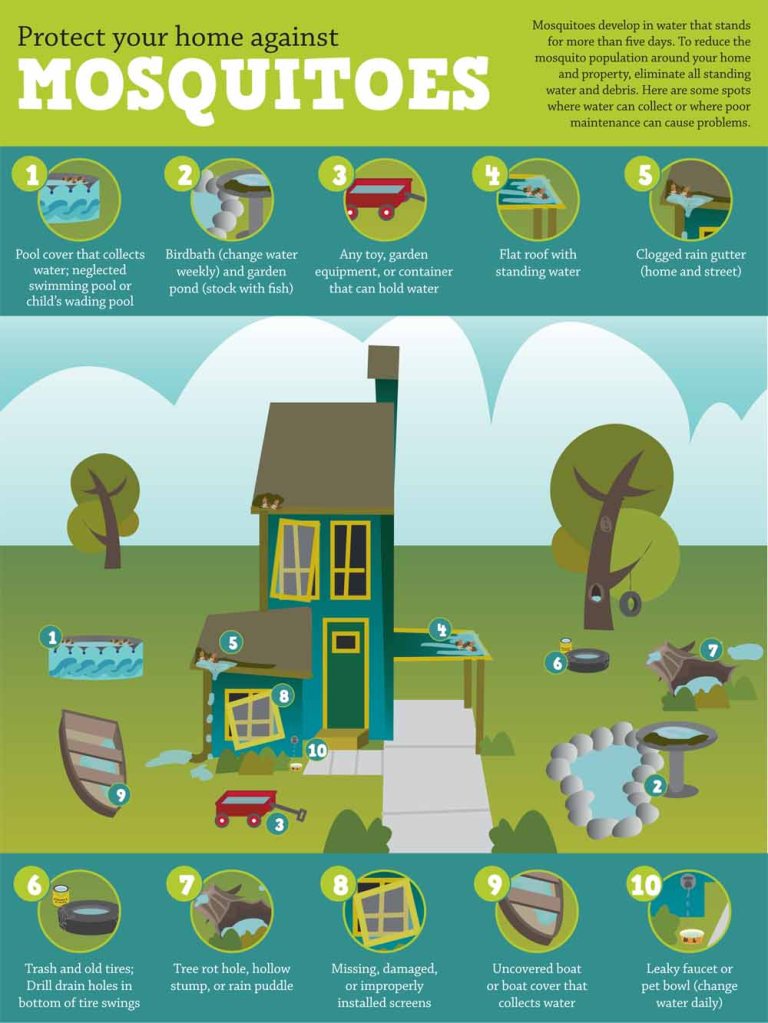
Keeping yards clean is imperative to eliminating areas of pooling water for mosquitoes to reproduce in. Piles of leaves and shrubs should be cleaned up, clogged gutters should be cleared, kids toys should not be left out, and objects that have the ability of holding any water should be dumped on a frequent basis. Figure 4 is a good representation of areas that require attention within a backyard to prevent mosquitoes from moving in and establishing a home base.

Lastly, as mentioned above, vaccines are available for some but not all mosquito-borne diseases. Two of the main diseases that have preventative vaccines are yellow fever and Japanese encephalitis. When traveling internationally, individuals should be aware of any possible diseases they can contract from their destination and vaccinate accordingly.

Figure 4. Precautions to take at home to protect yourself from mosquitoes

Final Thoughts

Increasing mosquito populations and their diseases evolving and spreading more readily is just another example of such a small yet large impact of climate change. Unfortunately, our country is predicted to undergo an upward trend with increasing greenhouse gas emissions, which causes an overall increase in temperature. Therefore, the mosquito population is expected to increase, as they thrive in warmer weather. Additionally, the regions in North America that will receive more precipitation are prone to more standing water and swampy areas, both of which will attract mosquitoes. With all of this in mind, we need to make ourselves aware of the changes our planet will experience and educate others.

It is becoming more and more straight forward that human-induced climate change impacts so many aspects of life. However, it is hard to think of the impacts on such a microscopic scale, rather than a big picture. For example, most know that droughts, a possible cause of climate change, will cause water shortages. However, national security can become an issue due to individuals leaving their country illegally to seek the proper necessities, and this is an issue that does not come to mind at first.

Signing off

-Shannon

Sea Level Rise

Sea Level Rise is a huge threat to humanity, as it causes many national security and environmental refugee, health, economic impacts and will leave areas uninhabitable.  The danger posed by Sea Level Rise is very significant.  In this blog post I will be discussing Sea Level Rise, the projections, causes, current data, who vulnerable and what we can do about it.

Currently the sea is rising at 3.3 millimeters per year.  That may not seem like much but it has some serious implications and this rate has been increasing (NASA Climate Change).  The average sea level has risen 8-9 inches between 1880 and today, and just in the last 25 years a third of that has occurred.  I say average because the sea doesn’t rise at a uniform rate because of meteorological, geological, and oceangraphical reasons for example the strength of winds and ocean currents and land rising from the last ice age (climate.gov) (Magnusson).  

data graph

Currently several areas have been affected by sea level rise. Let’s start our field trip in Southern Florida.  In Southern Florida, the sea level has risen to a point that now “King Tides” or significantly high tides are flooding communities that usually are not affected by them.  This water is flooding parking lots, streets and into homes and businesses.  The flooding is becoming worse and more common.  This also is a threat to water lines, from saltwater getting into the drinking water supply.  Florida also has porous soil that makes water more easily flow through the soil (Tampa Bay Times).  Another area is Bangladesh where the seas are flooding rural areas.  This leaves soil infertile and erodes the soil.  Each year 50,000 to 200,000 people are displaced by erosion and sea level rise and that isn’t counting those who leave after cyclones hit.  This has created a situation of “environmental refugeeism”, where hundreds of thousands of Bangladeshis move to the city, Dhaka and end up in the city’s poorest areas.  Scientists predict by 2050 17 percent of the country will be submerged and 20 million will be displaced. Dhaka isn’t immune to flooding either.  Most that move live in nonpermanent shelters and have little to none potable water, have little to eat and bathe and drink from a river, in which trash and industrial waste and sewage are dumped straight into the river.  The city doesn’t provide them with basic services because it doesn’t want them to be “permanent.” They work in jobs like a trash picker or in garment factories. Bangladesh isn’t a huge country, about the size of Iowa.  Other than the sea Bangladesh is completely surrounded by India. India doesn’t really want anything to do with migrants from Bangladesh (National Geographic and Marcin Szczepanski.) Back in the US, in Louisiana a whole community of Native Americans is having to relocate.  The community is called the Isle de Jean Charles.  Sea Level Rise, and Soil Subsidence is pushing this community into the ocean.  The tribe of Biloxi-Chitimacha-Choctaw Native Americans is having to move from their historical homeland as 2,000 square miles of Louisiana delta is disappearing.  The island was in 1955 22,400 acres but now its only 320 acres, and it extremely close to losing its only access road.  The US Department of Housing and Urban Development has given a $48 million relocation grant to relocate the community (Ted Jackson). Also communities in Alaska are succumbing to sea level rise, sea ice retreating, permafrost melting and coastal erosion. Most of these communities are also native communities (Oliver Milman). Also island nations in the Pacific are succumbing to sea level rise. One of them Kiribati is so much in danger is bought land in Fiji to relocate to when their home disappears beneath the waves.  Sea Level Rise is reducing the ability to grow food and have fresh water.  In New York City, Hurricane Sandy’s storm surge was made 11.4% worse than it would without sea level rise.  And Hurricane Sandy isn’t alone, if Hurricane Katrina had climatic and the sea level factors of the 1900s, the storm surge would have been 15% to 60% lower.

            Sea Level Rise is has two main causes, loss of glaciers and ice sheets and heat expansion. First Land-based ice for example on Greenland and Antarctica and Glaciers melts leading to a rise in the sea level.  The two most worrying of these are the Greenland and West Antarctic Ice Sheets.  If the Greenland Ice Sheet completely melted, the sea level would rise 6 meters or 20 feet. The Greenland Ice Sheet is 656,000 square miles. Summer melt on the Greenland Ice Sheet increased by 30% from 1979 to 2006. If the West Antarctic Ice Sheet melted sea levels would rise 3.2 meters.  Together that would make more than 9.2 meters or 30 feet, something almost unimaginable (and that isn’t including mountain glaciers). These ice sheets are connected to the ocean by glaciers.  Most worrying about West Antarctica Ice Sheet is that it sits below sea level and that warm ocean water meets the grounding line below the glacier’s ice tongue and making these glaciers unstable and if these collapsed it could lead to a gradual collapse of the entire ice sheet (National Snow and Ice Data Center) (Antarcticglaciers.org) (Carolyn Beeler).  Glaciers are also melting at alarming rates.  Nine thousand billion tons of ice melted between 1961 and 2016 from mountain glaciers.  This could be 25 to 30% of sea level rise (Olivia Rosane).  Another cause is warming waters.  As waters warm from climate change, they expand leading to larger seas (climate.gov).

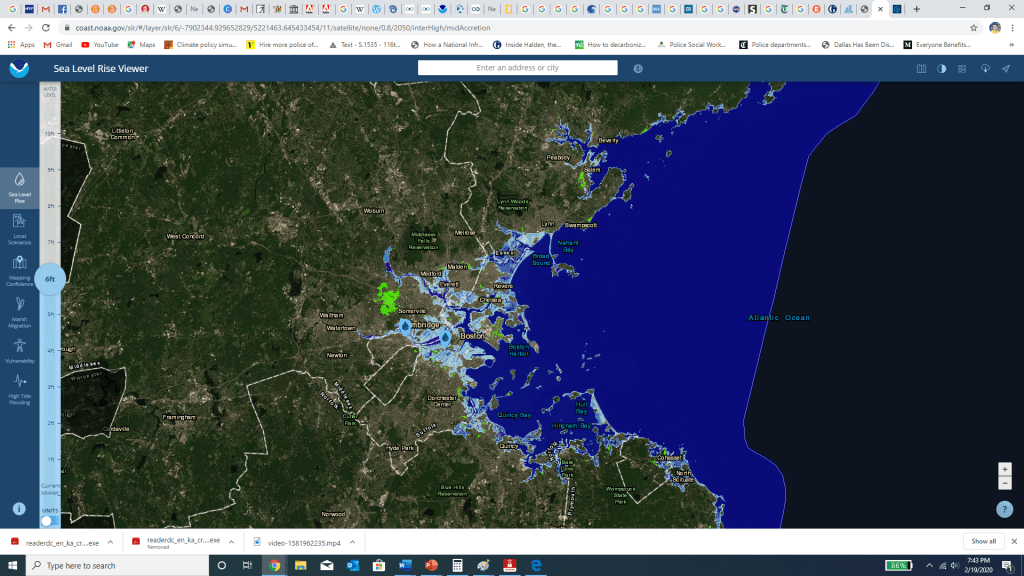
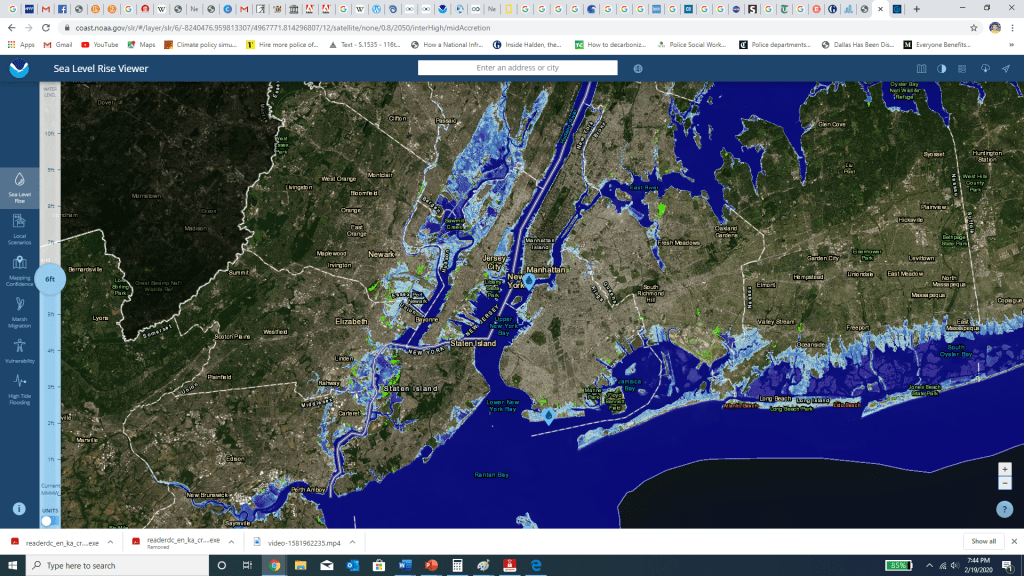
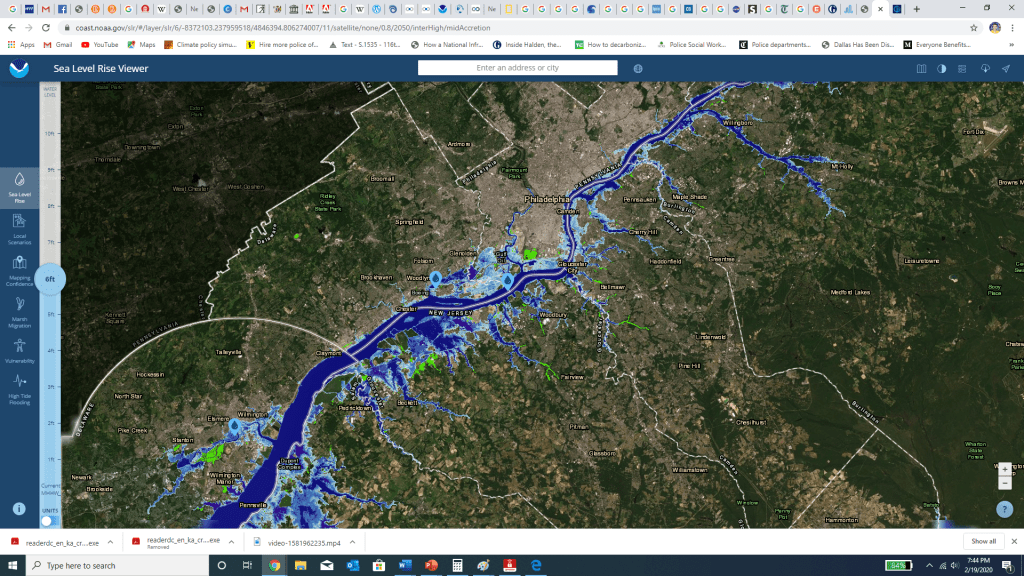
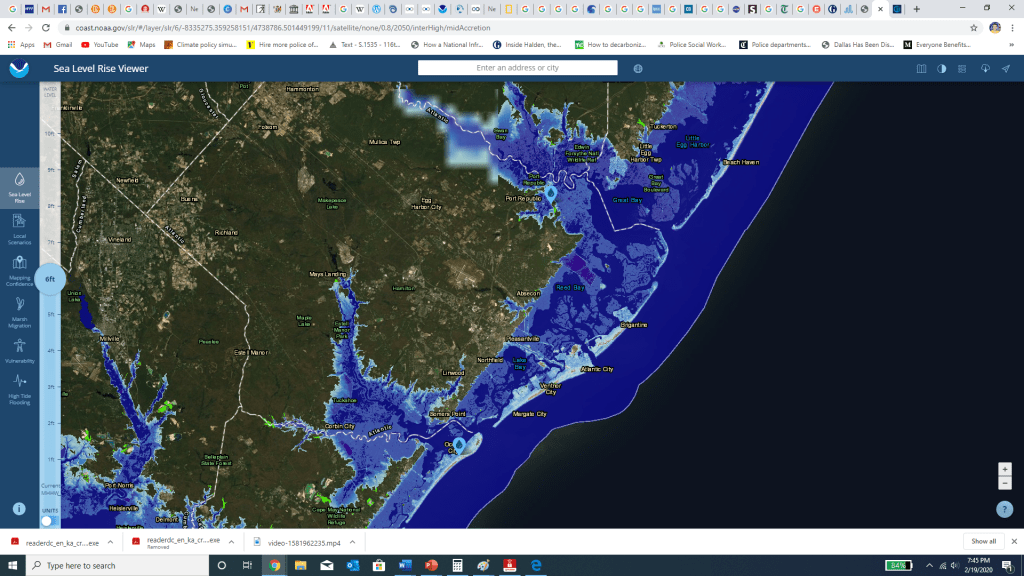
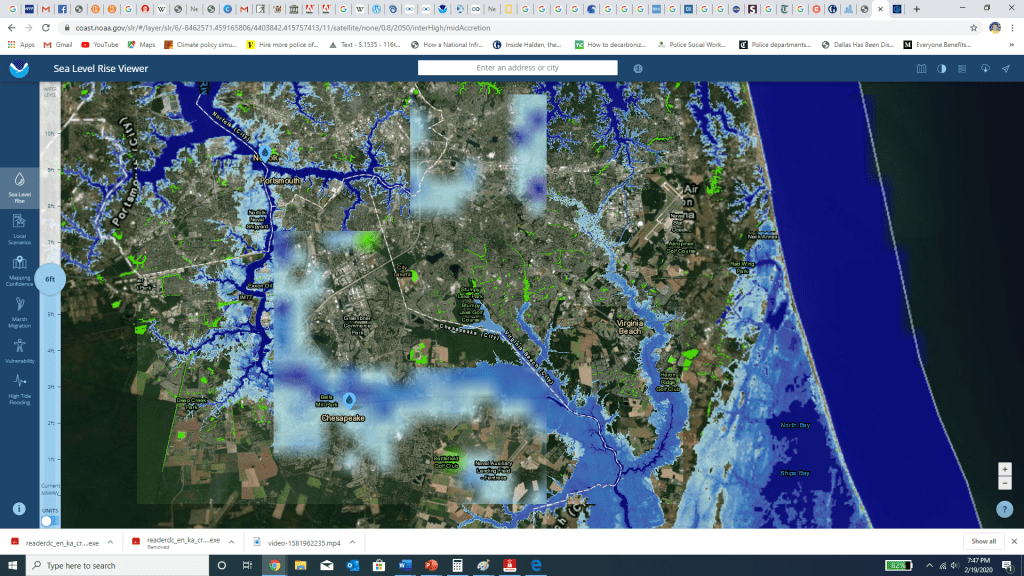
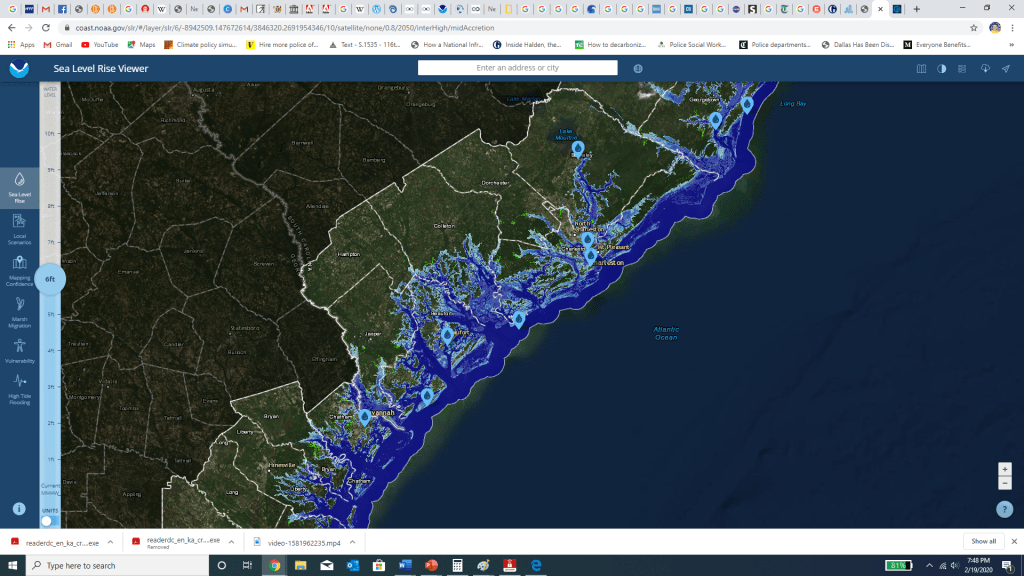
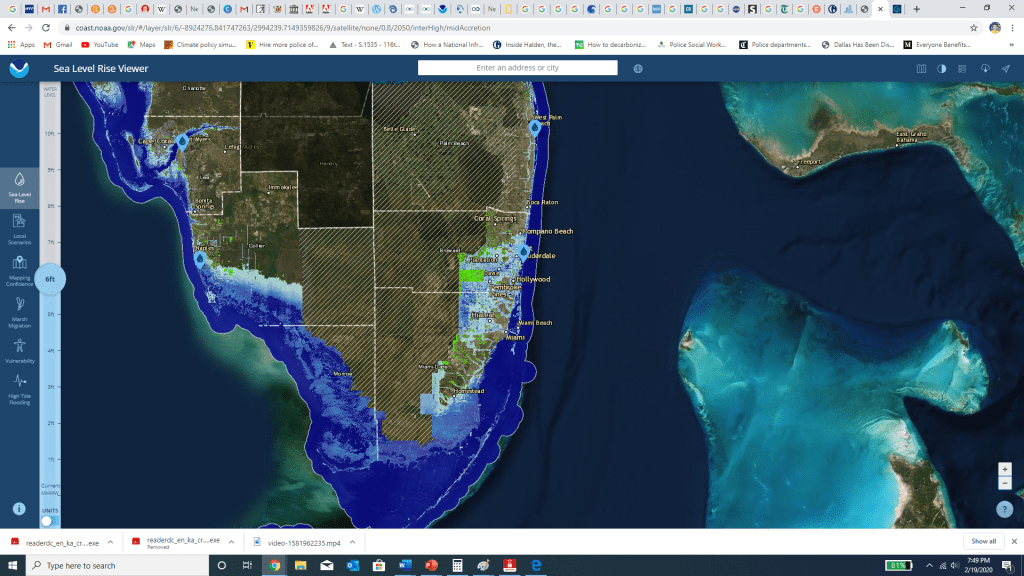
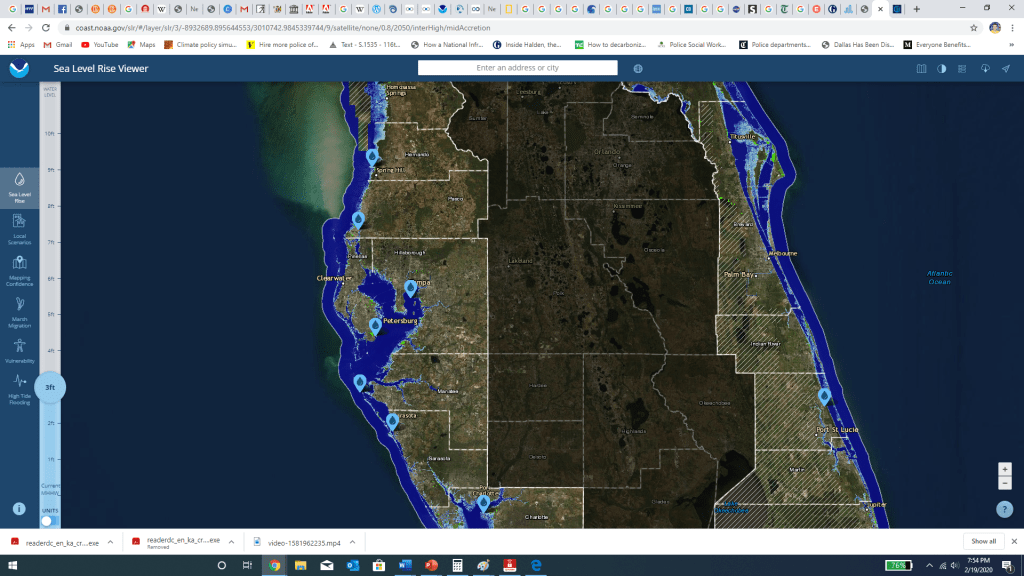
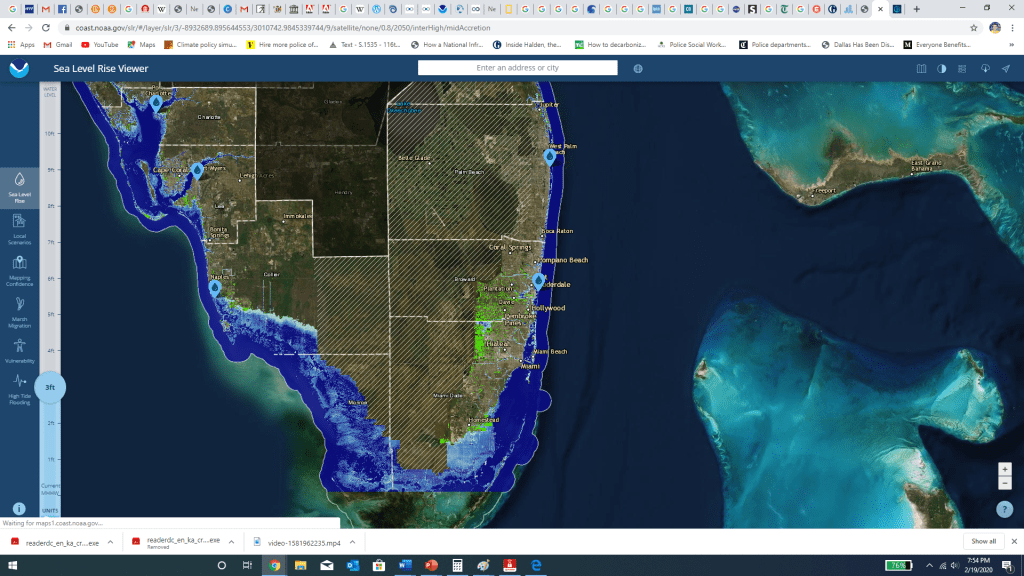
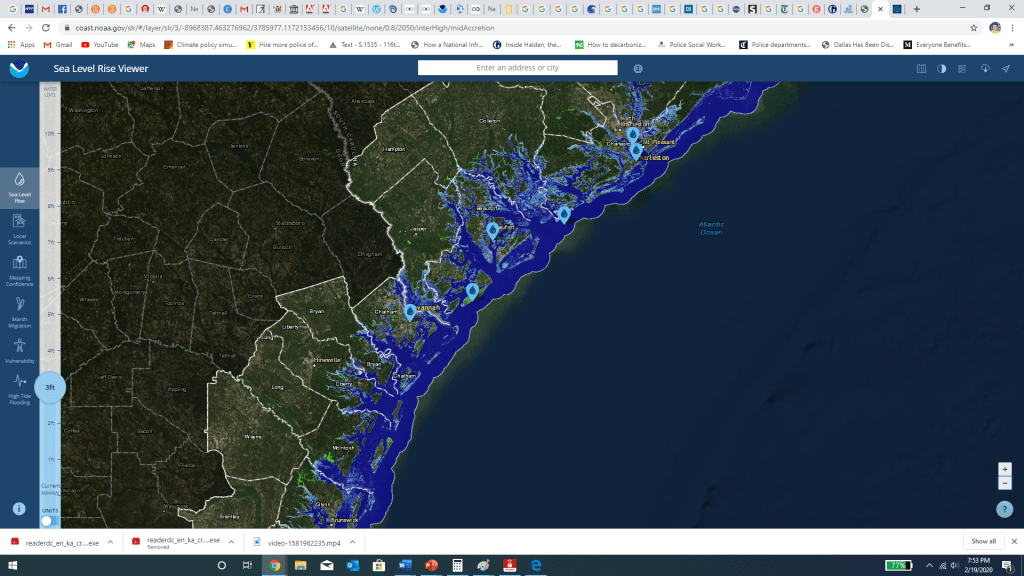
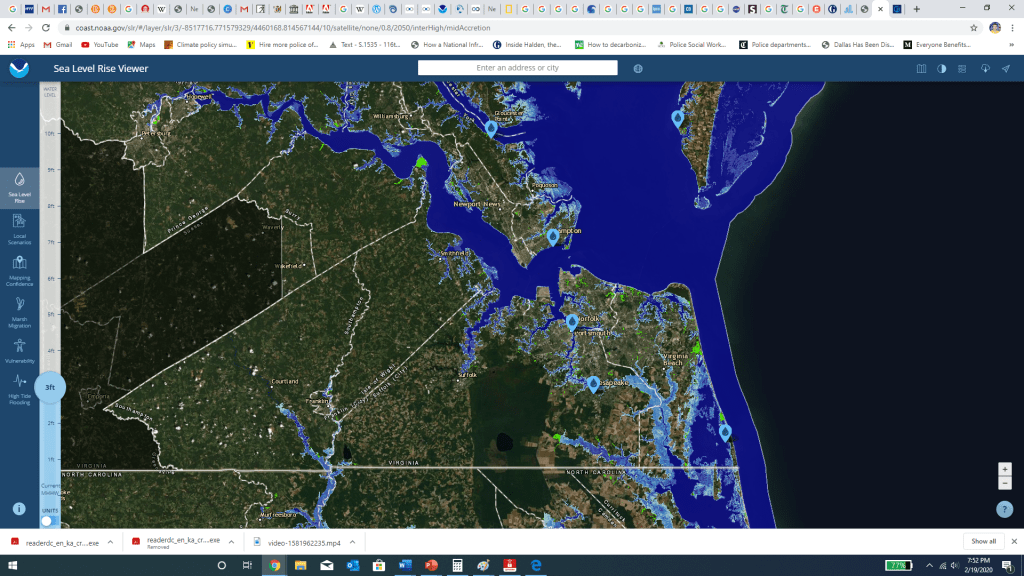
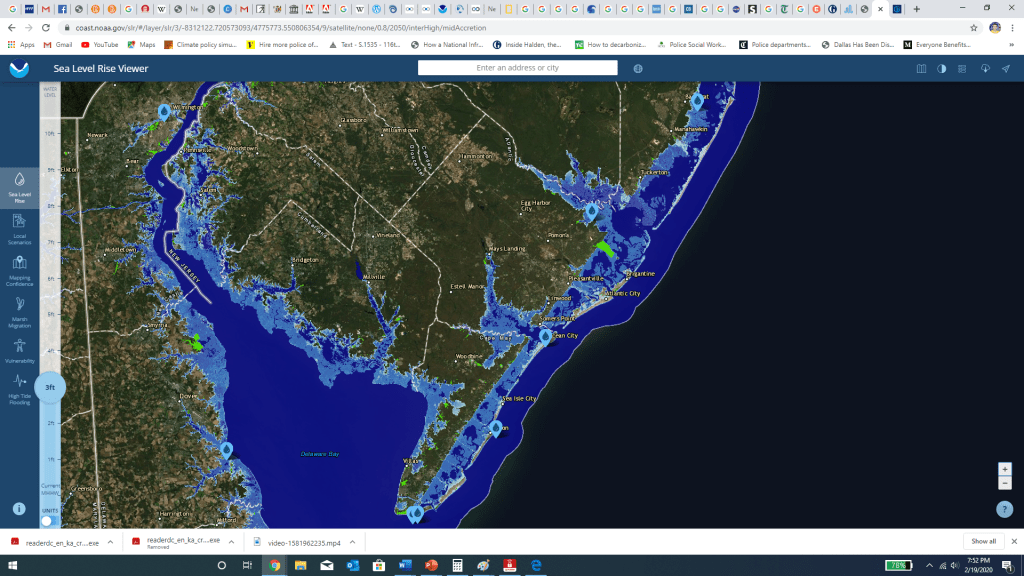
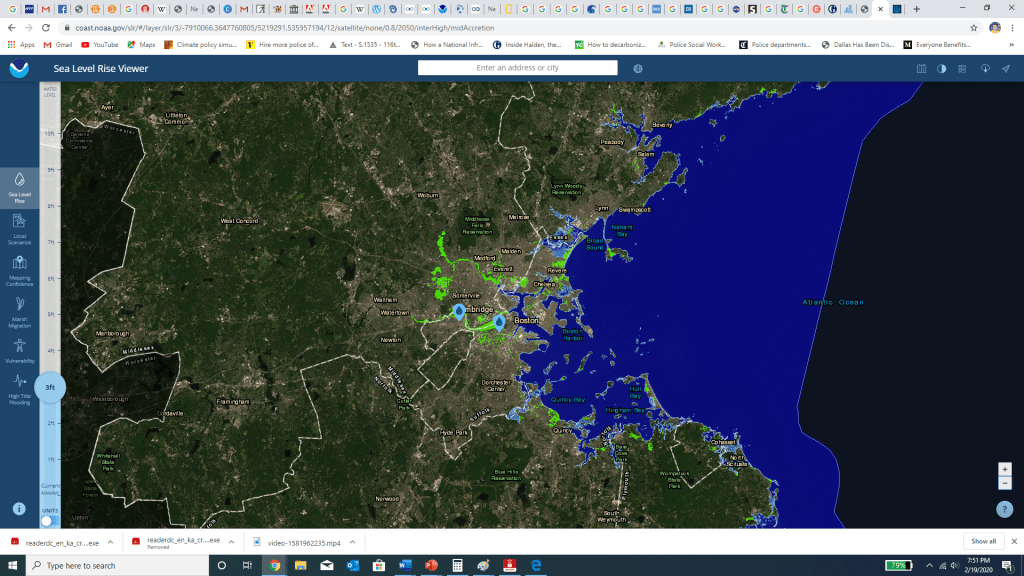
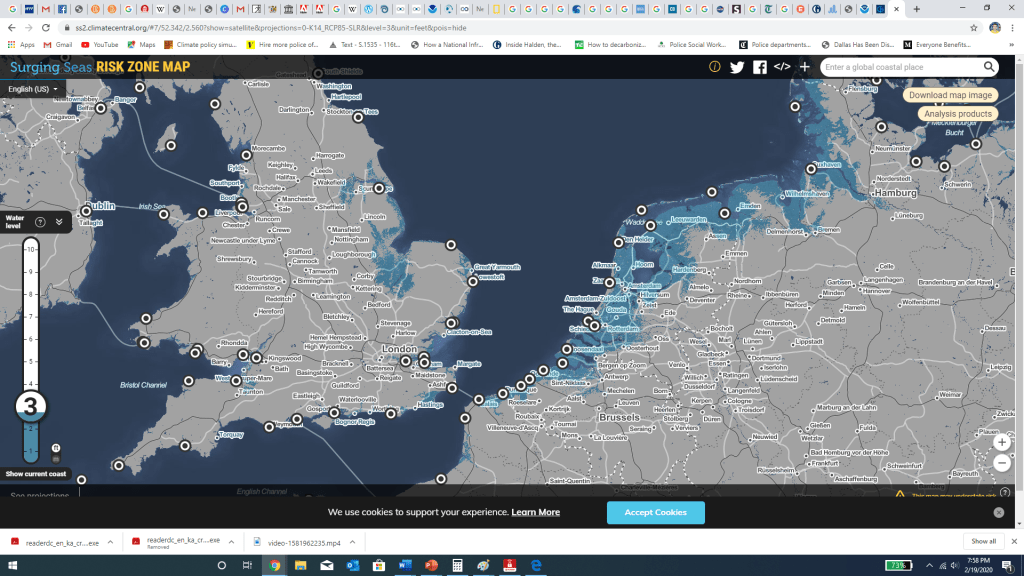
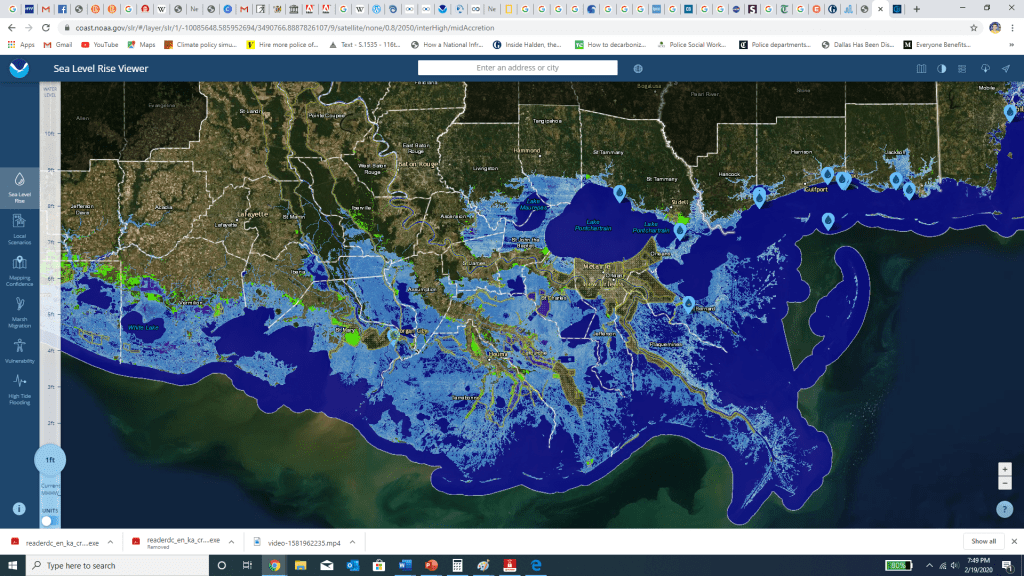
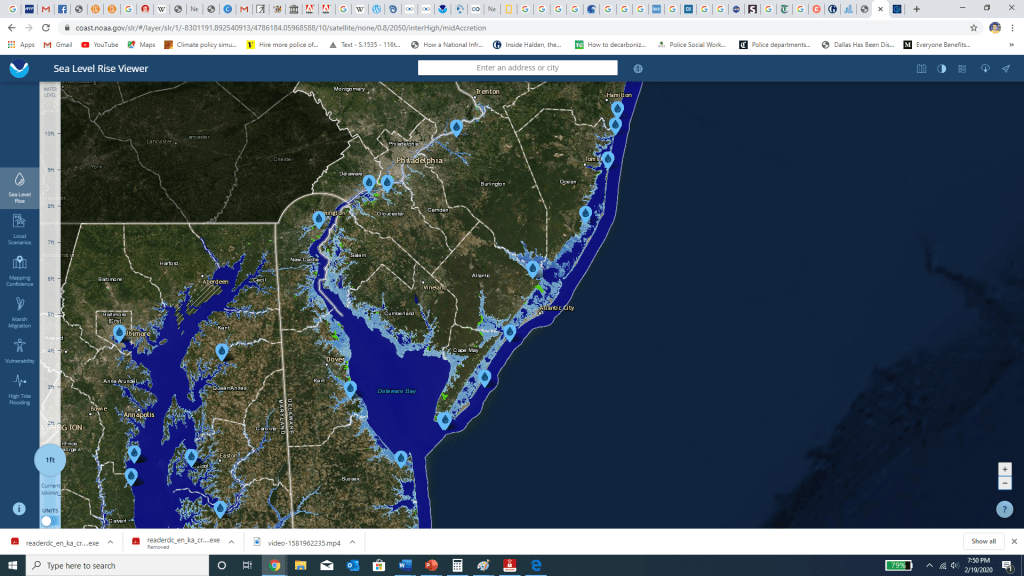
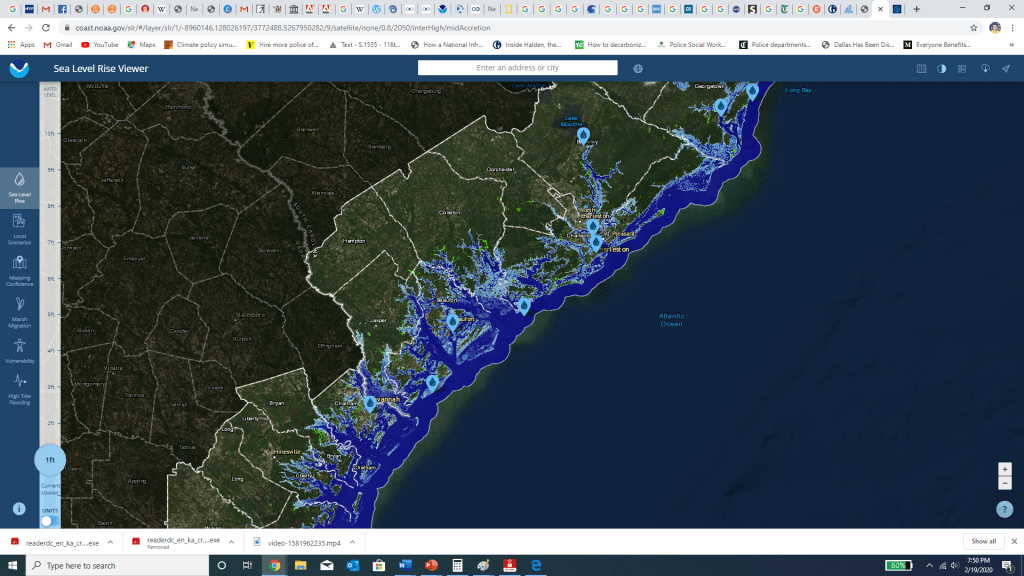
            Current Average projections for the world average sea level from the Intergovernmental Panel on Climate Change is if we stay below 2 degrees Celsius of warming we’ll have a range of 1 to 2 feet, if go over 2 degree we will have a range 2 to 3.6 feet.  But the IPCC also said in its “Special Report on Oceans and the Cryosphere” that 6 feet of sea level rise “cannot be ruled out.” Below I have some pictures of sea level rise in different parts of the world.

6 ft—Boston

6 ft—–New York City

6 ft—-Philadelphia

6 ft—–Atlantic City and New Jersey Shoreline

6 ft—-Norfolk Naval Base

6 ft—–Savannah, Georgia and Charleston, South Carolina

6 ft—-Miami

Florida 3 FT

Charleston, South Carolina, 3ft

Norfolk Virginia 3ft

New Jersey Seaboard 3ft

Boston 3ft

England and the Netherlands 3ft

Louisiana 1 ft

New Jersey Seaboard 1 ft

Charleston, South Carolina 1 ft

For southern Florida the IPCC predicts by 2030, 6 inches more sea level rise on average, and on the high end of scale NOAA predicts a foot.  By 2060, the IPCC predicts 14 inches and NOAA predicts 2.8 feet.  By 2100 the IPCC predicts 2.58 feet and NOAA predicts 6.75 feet.

Sea Level Rise brings with it a host of problems, first higher seas contribute to higher storm surge and larger flood areas during hurricanes and other large storms.  For example what I said earlier with Hurricane Sandy.  This can also contribute to coastal erosion and there but subsidence.  The flooding can cause people to be stranded without help and will break down infrastructure.  It can also kill people trying to swim or drive in the water.

Also a problem is that sea level rise will push people further inland causing fights over resources, and over land.  This makes area more conflict prone and could bring us into wars.  The US Department of Defense named climate change a “threat multiplier” for this reason. This is very serious concern and could be the worst impact climate change has. Also Sea Level Rise is harming military bases like the home of the US Atlantic Fleet, Norfolk.

The Loss of economic assets and since we are not being very keen to realize the impacts of sea level rise on our infrastructure and buildings, this could cause a large economic bubble, which could lead us into a depression or recession.  Also globally the world economy could lose more than 4% of its GDP just from sea level rise, without further mitigation or adaptation.

Relocating communities because of sea level rise can cause problems in its own including mental health, social networks, historical heritage, water and food security, sanitation, and health care.

Last but not least there is saltwater intrusion which cause saltwater to seep into our water supply systems and leave areas without potable drinking water.  This is a concern for many areas of the along the coast.

To adapt to Sea Level Rise there is a bunch of things we can do.  To protect communities we can build dikes and seawalls and sea gates to protect areas.  We can put buildings on stilts to allow the sea into areas while protecting our buildings.  We can redirect water into areas for example parking lots and parks, and floating communities.  We can use large pumps to pump out water from underground or from in our streets. We can retreat from the coast line and we should put money towards communities being able to do that. We can raise infrastructure to make sure critical infrastructure is not affected by flooding.  We can invest in the water supply infrastructure to keep that safe.  There is a lot of things we can do stop sea level rise but probably the most important one is reaching net zero emissions.

Hierarchy of adaptation options graphic

Thank you for visiting and looking at my blog post.

Sincerely,

Brendan Wissinger

https://www.climate.gov/news-features/understanding-climate/climate-change-global-sea-level

https://www.climatecentral.org/what-we-do/our-programs/sea-level-rise

https://www.climatecentral.org/news/report-flooded-future-global-vulnerability-to-sea-level-rise-worse-than-previously-understood

https://oceanservice.noaa.gov/facts/sealevel.html

https://www.globalchange.gov/browse/indicators/global-sea-level-rise

https://sealevel.climatecentral.org/research/methods/projecting-sea-level-rise/

https://www.nationalgeographic.com/environment/global-warming/sea-level-rise/

https://ocean.si.edu/conservation/climate-change/map-boston-3-meter-sea-level-rise

https://insideclimatenews.org/news/24012017/sea-level-rise-global-warming-federal-report-donald-trump

https://toolkit.climate.gov/topics/coastal/storm-surge

Click to access DOE-OE_SLR%20Public%20Report_Final%20_2014-10-10.pdf

https://www.ucsusa.org/resources/underwater

https://www.climatecentral.org/news/adapting-to-sea-level-rise-could-save-trillions-by-2100-17034

https://www.weforum.org/agenda/2019/04/how-will-retreating-from-the-sea-affect-our-health

https://www.sciencedaily.com/releases/2020/01/200127134809.htm

https://e360.yale.edu/features/rising_waters_how_fast_and_how_far_will_sea_levels_rise

https://www.climatecentral.org/gallery/graphics/storm-surge-and-sea-level-rise-advancing-waters

https://www.businessinsider.com/sea-level-rise-3-feet-in-80-years-un-report-2019-9

https://www.wlrn.org/post/south-florida-doomed-sea-level-rise-experts-say-no-fact-theyre-optimistic#stream/0

https://www.nbcnews.com/news/us-news/rising-seas-threaten-norfolk-naval-shipyard-raising-fears-catastrophic-damage-n937396

https://www.neefusa.org/nature/water/groundwater-and-rising-seas

https://www.cgg.wa.gov.au/live/my-environment/coastal-hazard-risk-management-and-adapta

tion-planning/adapting-to-sea-level-rise.aspx

Click to access 15-117-NCCARFINFOGRAPHICS-5-03%2812Apr%29-UPLOADED.pdf

https://www.euronews.com/2019/10/14/rising-sea-levels-how-the-netherlands-found-ways-of-working-with-the-environment

https://www.nrdc.org/onearth/bangladesh-country-underwater-culture-move

https://www.tampabay.com/news/environment/2019/11/01/king-tides-are-a-glimpse-into-future-with-rising-seas-for-many-flooding-is-the-new-normal/

https://e360.yale.edu/features/on-louisiana-coast-a-native-community-sinks-slowly-into-the-sea-isle-de-jean-charles

https://www.theguardian.com/world/2017/oct/23/waiting-for-the-tide-to-turn-kiribatis-fight-for-survival

https://www.theguardian.com/us-news/2017/aug/10/alaska-coastal-towns-sea-level-rise-climate-change

https://www.theguardian.com/us-news/2017/aug/10/alaska-coastal-towns-sea-level-rise-climate-change

https://www.climate.gov/news-features/features/superstorm-sandy-and-sea-level-rise

https://www.nationalgeographic.com/environment/2019/01/climate-change-drives-migration-crisis-in-bangladesh-from-dhaka-sundabans/

https://www.climatesignals.org/events/hurricane-katrina-2005

https://nsidc.org/cryosphere/quickfacts/icesheets.html

https://interactive.pri.org/2019/05/antarctica/thwaites-glacier-collapse.html

https://www.weforum.org/agenda/2019/04/melting-glaciers-causing-25-to-30-of-sea-level-rise

https://www.nhc.noaa.gov/surge/

https://climate.nasa.gov/

Surging Seas of Climate Central: https://ss2.climatecentral.org/#8/22.294/110.391?show=satellite&projections=1-K14_RCP85-SLR&level=6&unit=feet&pois=hide

Sea Level Rise Viewer of NOAA: https://coast.noaa.gov/digitalcoast/tools/slr.html

Climate Change’s Impact on Biodiversity

Why is Biodiversity important?

A healthy ecosystem requires a large variety of different plant and animal life. Rich biodiversity increases ecosystem productivity. For example the more species we have on the planet the more they can all depend on each other. Human health can be affected by biodiversity because by having a variety of plants, fungi, and animals, we buffer our bodies against disease and infection, and we can also use certain plants to make medicines that treat disease and infection. Having rich biodiversity also ensures we have clean air, water, soil, and other materials we may need. The air we breathe is cleansed by contributing members of the ecosystem. With more species becoming endangered and extinct everyday, the future can be uncertain. When one species is lost, it causes a chain reaction and other species will continue to be lost. 

How is Climate Change Playing a Role?

Climate change is an abnormal shift in climate patterns, it will cause the world to fluctuate along with the ecosystems around it. With temperatures and sea levels rising around the globe, it is making it difficult for plants and animals to adapt to these changes. Those who cannot adapt will die. One huge example of this is the coral reefs. Coral reefs are part of the most diverse ecosystem on the planet. They provide protection from the damaging effects from storms, and they provide shelter and habitat for many marine organisms. We also use the coral reefs to make certain medicines that help us survive. It is estimated that 27% of coral reef systems have already been destroyed and 32% is at risk of being destroyed over the next 32 years. With the coral reefs dying off, this leaves many marine organisms at risk without proper habitat, and nutrition. 

Altered land use

The destruction of land to create new cities and agricultural fields can shift climate, this is due to the chopping down of trees and plants that cool the atmosphere. Natural landscapes that are destroyed to create agricultural fields are causing more greenhouse gases to be emitted into the atmosphere because it is used for more food production. Overpopulation is a key factor in this. One way we could partially solve this problem is reducing the amounts of chemicals we use in agriculture production, or finding more eco-friendly methods. With the destruction of land also comes the destruction of habitats that species live in, this is contributing to the mass extinction rates we are having now. 

How can society reduce biodiversity loss?

There are many ways we as society can reduce the loss of biodiversity. A good place to start would be investing in more eco-friendly options, reducing meat consumption, and donating to agencies like the World Wildlife Foundation that are already helping the cause. Be overall more aware of what you are putting into the environment around you!

-Kaila Teets

Climate Change and Arctic Feedback

Climate change is an overarching phenomenon that is affecting all parts of the world, as well as being affected by all parts of the world. The aspect of one change causing subsequent changes is called ‘feedback’. Feedback is called ‘positive’ when the subsequent effect enhances the initial cause, similar to how running on a hot day makes you feel even hotter. Feedback is called ‘negative’ when the secondary effect works against the initial effect, like how it requires more effort to juice an orange that is already half juiced, than one that is has not been juiced at all. These feedbacks on the climatologic scale can play a pivotal role in how climate change can worsen over time. This phenomenon can most easily be tracked within the Arctic Circle, so we will focus there for this piece.  

            The feedback mechanisms over the land and the oceans differ, so we will discuss over land factors now and oceanic mechanism later on. The initial mechanism is a generally warming atmosphere due to the effect of increased levels of greenhouse gases. Most land within the Arctic Circle is covered in a layer of permafrost with varying duration and thickness. Permafrost is when the ground is frozen solid form most of the, if not the entire, year due to the cold temperatures. As the atmosphere starts to warm, so too does the ground underneath of it. This will gradually thin and deplete the permafrost over time. The main cause for concern here is that there is significant amount of methane gas trapped underneath of the permafrost across a large area of the land within the Arctic Circle. This methane exists in these areas as the result of decaying biologic matter from thousands to millions of years prior. Methane is itself a powerful greenhouse gas, and would only worsen the ongoing greenhouse effect. This creates a loop of positive feedback, where the warming of the atmosphere causes permafrost to melt, which releases additional greenhouse gases into the atmosphere, causing a cyclic pattern that will continue to worsen autonomously. Additionally, and contrary to what some will state, there isn’t much benefit to be gained from the no longer frozen land. The land will be unstable, so buildings will not be able to be constructed on it, and it will be very poor for agriculture, so large scale farming cold not occur.

            Feedback mechanisms also are present over the oceans within the Arctic Circle. Most of the oceans within the Arctic Circle are covered in ice permanently or semi-permanently for most of the year. The warming of the atmosphere is causing more of the permanent ice to become seasonal, and the edges of the existing seasonal ice to disappear. This causes a positive feedback due to the decreasing albedo of this region. Albedo is a measure of the reflectivity of a surface, and decreasing the albedo of a surface proportionally increases its ability to absorb light and heat. This follows that: warmer atmosphere melts some of the ice, the exposed ocean is less reflective than the ice and can absorb more heat, thus warming the neighboring ice more, and creating a circular pattern of melting arctic ice sheets. In theory, the increase in ocean surface could also create a negative feedback because some atmospheric carbon dioxide can be absorbed into the newly exposed ocean. However, this effect would be incredibly minute compared to the rate of absorptive warming, let alone the rate with which new carbon dioxide is entering the atmosphere through the burning of fossil fuels and other human causes. A secondary effect of the melting of the existing sea ice is the collapse of the local ecosystems in this area, as the habitat for arctic animals melts away into nothing.

            So, to sum up, climate change is affecting the entire world. There are many factors that influence the effects that climate change will have on an area, as well as the intensity of those changes. As demonstrated by our selected area of study, many of the aspects of climate change are part of a feedback loop of some kind. The majority of are a positive feedback that worsens the existing patterns of change. Some negative feedback loops that work against the existing patters do show up, but are unfortunately rendered inconsequential at the larger scale. This could however be used for our benefit as well. These loops would work in reverse, meaning that if we could lessen the initial causes, the lops would help to create a trend where less change could happen, which is the ideal scenario for successful continuous inhabitation of the Earth.    

Design a site like this with WordPress.com
Get started