By Brendan Wissinger
For this Blog Post, I am doing it on the subject of Climate Denial. There are several types of Climate Denial. There is denial for financial, political and personal reasons, and then are similar ideologies that also promote inaction on the climate crisis: Doomism and the “I admit is exists, but I won’t do anything about it” mindset.
First let’s debunk some denialist claims on the Climate Crisis.
- “Its caused by natural causes“
- Its not the sun because the sun’s energy has decreased
- Its not volcanoes because they have not significantly increased or decreased.
- Its not changes in Earth’s orbit or axis because those don’t affect smaller timescales.
- On the other hand it is because of humans because there are certain fingerprints of human activity in the climate for example nights are warming faster than days pointing to the warming having to do with the greenhouse effect, another there is less oxygen in the atmosphere (not enough difference to effect us) pointing to the burning of fossil fuels.
- “It’s snowing”: That is weather not climate.
- “It’s been warmer before during the medieval warm period”: Actually it wasn’t warmer during the medieval warm period.
- “The Climate has always Changed”: Why, does this matter? If you’ve never had something happen to you before, that doesn’t mean that it can’t ever happen to you. Especially when before there was never a species with industrial technology to do it with. Sure, the climate changes, but it changes on account of many different factors, and right now humans are the forcing.
- “Its too costly”: Not acting is too costly. The costs of not acting on Climate Change are incalculable (Skeptical Science). The cost of stopping the Climate Crisis would cost around $13 trillion (MIT), the cost of inaction is over $44 trillion (CNBC).
- “Climate Change will be good for us”: All scientific evidence points to climate change being overall bad for us. The Climate Crisis will negatively effect our economy, possibly sending into a semi-permanent economic great depression, it’s a major threat to public health, national security, agriculture and our environment.
- “We shouldn’t act because other countries are not acting”: This doesn’t make any sense, if you apartment building is burning, you don’t not run out because your neighbor didn’t.
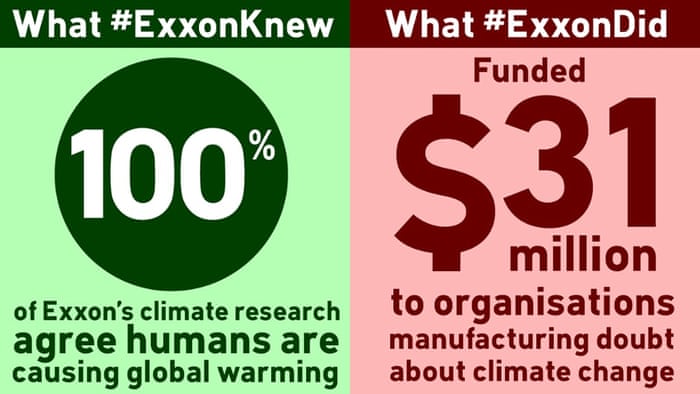
If we were to act many large companies and CEOs would stand to lose a lot of money because of decarbonization, though it would help our economy. Actually fossil fuel industries wouldn’t exist and so they have funded a large campaign of misinformation and bribery to stop any action on the crisis even though they know that climate change was occurring. For example the fossil fuel industry. The fossil fuel industry knew about the crisis as early as 1977, before the public knew about it, but instead of diversifying their industry, they spread disinformation claiming the “science wasn’t settled” and that “climate change is good” and that “climate change is caused by natural forces not human ones”. They bribed officials and used their disinformation campaigns to make sure climate deniers got elected and stayed in office, blocking any climate legislation and encouraging politicians to give more subsidies to the oil industry. The campaigns of many republican politicians, for example James Infole who famous held a snowball on the senate floor, claiming it was evidence that Climate Change wasn’t real. Similarly an Australian Senator held up a piece of coal and said it looks harmless so it must be harmless. They have funded think tanks for example the Heartland Institute and Americans for Prosperity. The merchants of doubt funded campaigns denying the Crisis. They are now using social media to try to spread denial. An example is that of youtube videos, ones that don’t accept the consensus on the Climate Crisis outnumber ones that accept the consensus. They have spread lies to try to discredit climate scientists, and convince a large portion of the American public that the climate crisis isn’t real.

Denial is also done because it may algin with people’s political views or they are scared of acting on it or scared of the Climate Crisis themselves, psychologists call this “motivated interference.” For example a coal miner may not believe in the existence of Climate Change, because believing in it would mean he would have to allow people to hurt his career path. For a republican wouldn’t believe it because most of his or her party doesn’t acknowledge its existence. Someone that is directly effected by the Climate Crisis may not believe it exists, because they don’t want it to exist. Denial is a self-defense mechanism meant to allow an individual to keep their mental health, but in modern times it can only hurt us because whether we believe in it or not, it still exists, and we can do thinks about problems we personally don’t have much control over for example voting. Just because someone denies something doesn’t necessarily mean that they are easy to win an argument with, because many deniers then use false evidence to build up their own reality. Psychologists call this “motivated reasoning.” Instead of deciding facts from an impartial facts, they cherry pick their facts and create their own reality. Deniers tend to be lower educated, older and more religious than people who accept the Climate Crisis.
In many countries, if not almost all, most people say Climate Change is a threat to their countries, even in the US, and Australia. In the US 59% of people say the Climate Crisis is a major threat to the US. But there are large amount of people who think the Climate Crisis is only a minor threat, 23% and or no threat, 16%. Even though 97% of climate scientists agree that human caused climate change is occurring. But concern is increasing across the world. In the US 83% of democrats believe the Climate Crisis is major threat to the US, and only 27% of Republicans believe the same. Sixty-Seven of Americans believe that the federal government is not doing enough on the climate crisis. Sixty-Three of Americans say that environmental regulations should be put in place. Also over 60% of Americans said that the climate crisis is affecting their community. For the first time, the Climate Crisis is listed high among America’s priorities.
It is difficult to change a denier through facts and figures because humans primarily respond to emotions. Instead to change deniers we should focus on assuring them about solving the crisis can be done and won’t hurt them, and using conservative values of patriotism, order and defending nature can help reset views. But ultimately we’ve been wrong to focus on deniers, we should be focusing on the undecided and mobilizing the people who have decided but have not yet acted on the crisis.
The complexity and the size of the issue may make people not want to believe it exists. People don’t want to take the individual actions that we help get us to solving the Climate Crisis (not that individual actions are any more important than systemic action, systemic action is more important). The list of impacts and solutions to the Climate Crisis is so long it is difficult to memorize. Afterall my colleges have an entire class devoted to it (like the Class I am writing this for). And the problem doesn’t seem constant as climate disasters don’t happen every single day, at least for people in the Global North. The immensity of this issue makes it so telling facts and figures may actually push people away from acting and reinforce (or even start) denial. To motivate people to act, we need to come off in a simple, clear and emotional yet accurate manner. But rather we need to focus on solutions that we can do individual to try to overcome the fear we may feel about this problem and promote systemic action on the issue, but there is a limit to that, that coming on too strong can turn people away, into believing it but forgetting about it and doing nothing about it, which does the same thing as denial. We need to provide practical, viable and attractive alternatives. For example instead of saying we need to stop entirely eating meat, we need to cut back on meat, or instead of not going on any flights, say don’t go on one flight a year, and slow build up pressure to move away, one step at a time. Or instead of saying we need to ban all fossil fuels, saying we need to stop building new oil rigs in the United States. Or promoting public transport and renewable energy. Or bringing reusable bags to the supermarket, or replace all of your lightbulbs to LEDs, or cut down on the plastic. Better yet, the best solution to Climate Anxiety and Climate Guilt, is Climate Activism. So become an activist. And I am not saying you have to dedicate your whole to it, just some of your time.
But then there are the people we have pushed too far, who have become doomists, who believe that we can’t do anything about the Climate Crisis, so we should on like always over a cliff of doom, that at bottom of which is human extinction. Doomists may believe they are doomed for similar reasons that deniers do, or different ones. The doomists are not right either, we have time to stop this and end this. To end this we have to push forward solutions in an emotional, practical, viable, attractive, pragmatic, concise and accurate manner, mainly not pushing for individual solutions but political ones. For example if you’ve notice I have said the word’s climate crisis instead of climate change a lot, its because Climate Crisis gives a better response where it is enough to send an emotional response and sense of urgency but yet not too emotional to make it seem unreal.
We must push for massive political action to transition away from fossil fuel use, build renewable energy and public transportation, implement regenerative agriculture, and electrify housing and promote energy efficiency. It’s a tall order but it can be done and denying or it pretending doesn’t exist or saying we’re doomed won’t help us. We have to accept that this will be difficult road, but the alternative, it much much much worse.
 Global Climate Change and Society