Nuclear energy is a hotly debated topic in climate change discussions, and in general as well. What if I told you there is a way to do nuclear power that is safer for people, safer for the environment, cheaper to create, and safer to distribute? That is the power of using thorium metal as the fuel source for our nuclear energy.
Let’s talk about how nuclear energy is created. Uranium metal is mined, enriched, put simply a purification of sorts, so that it freely emits energy via fission through radioactive decay. This is cooled to maintain a state that is not meltdown, and this energy is collected, and distributed as any other power would be. Each one of these steps could be improved upon by the utilization of thorium in place of uranium. Once the metal is ready for use, the reactor generates nuclear fission, which is where one larger atom splits into two smaller atoms. This releases high-energy particles that are collected by the reactor, and the energy is siphoned and distributed as any other electricity. Figure 1 shows the sequence of decay for both thorium and uranium. As can be seen through this figure, thorium will decay into something stable significantly faster than uranium. Another thing that is a little harder to know, is that the materials thorium breaks down into are significantly less intense than those of uranium’s.
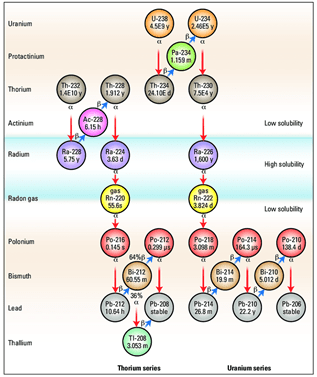
Figure 1: A chart shows the decay sequences of Uranium and Thorium. Courtesy of Nelson et al. via ResearchGate.
We’ll start with the acquisition of the metal itself. Thorium is more prevalent in the Earth’s crust in general, and it is also more concentrated in its ores as well. This means that, ounce for ounce, you would get more thorium than uranium from their ores. This would be more cost efficient because less mining and processing would need to be done to get the same amount of nuclear fuel. Keeping in mind that mining and processing damages the environment and creates greenhouse gasses, it has secondary benefits to climate change from the reduction of the mining effort.
On to the big one: safety. This metal is safer to use at every step or consideration. The way it creates energy is a little different. Uranium releases energy constantly by itself, unaided. Thorium is more stable, and requires the aid of a small amount of a more unstable material to agitate it. This is usually accomplished with a small amount of manufactured plutonium. This system is the source of the extra safety. Let’s say the cooling system fails due to some natural disaster. The uranium keeps emitting, without energy being collected, which leads to a buildup of heat, ultimately leading to a meltdown. As thorium heats up, it will melt, and fall away from its plutonium agitator, thus stopping the outflow of energy, stopping the meltdown. Figure 2 shows how the meltdown of uranium plants occurs.
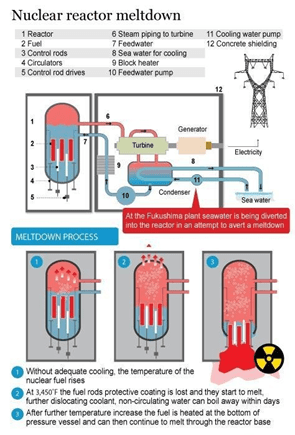
Figure 2: A diagram of how the meltdown at Fukushima happened. This is analogous to most meltdowns. Courtesy of NBC News.
To sum up, using thorium metal instead of uranium metal would be the by far better method of generating nuclear power. Thorium mining is a less intensive process, and doesn’t require nearly as much refinement of enrichment, and every step of this process is better for emissions and environmental destruction. The metal is all around safer for people and the environment, as it cannot meltdown in properly designed facilities, and it cannot be effectively weaponized. Uranium only persists due to the military industrial complex of the Cold War era, where weaponization was the primary consideration, and the energy was a side-effect. I think it’s time we made the switch.
Information Sources:
Source 1: Katusa, M., 2012: The Thing About Thorium: Why The Better Nuclear Fuel May Not Get A Chance. Forbes Business https://www.forbes.com/sites/energysource/2012/02/16/the-thing-about-thorium-why-the-better-nuclear-fuel-may-not-get-a-chance/#43130cbd1d80
Image Sources:
Figure 1:
Nelson A.W. et al., 2015: Understanding the Radioactive Ingrowth and Decay of Naturally Occurring Radioactive Materials in the Environment: An Analysis of Produced Fluids from the Marcellus Shale, Environmental Health Perspectives, 129. https://www.researchgate.net/publication/274400298_Understanding_the_Radioactive_Ingrowth_and_Decay_of_Naturally_Occurring_Radioactive_Materials_in_the_Environment_An_Analysis_of_Produced_Fluids_from_the_Marcellus_Shale
Figure 2: Boyle, A., 2011: If there’s a Meltdown, Then What?, https://www.nbcnews.com/science/cosmic-log/if-theres-meltdown-then-what-flna6C10403315
 Global Climate Change and Society