A common argument given by the denialist sect of people is the we can’t trust forecast modeling because everyday weather modeling isn’t accurate. Forecast modeling both for the climate and the weather, which are not exactly the same thing, can be complex to understand, and frankly, a bit boring to look at the machinations of, if that isn’t your kind of thing. My goal here is to summarize the differences and similarities of the two models, go over the kind of math involved (mostly statistical analysis), and generally dispel the attitude that forecaster don’t have any idea what is going to happen.
Let’s define what models are, and the differences between them. A model can be thought of, most simply, as a computer simulation. You enter data in, the computer stores and processes it, and then returns a model simulation. Models are used in just about every field that involves any kind of remotely intensive mathematics and/or scientific concepts. These include, but are not limited to: engineering, medicine, astronomy, economics, and, of course, climatology and meteorology, the issue currently at hand. The primary difference between meteorological and climatological models is time they run over. Meteorological models only run for a week or so, with some being ran longer. Whereas, climatological models are running for decades and centuries. The relatively short run time for meteorological models means that they can safely negate changes that take years to occur, like plate tectonics for instance. Neglecting the long-term changes simplifies the data the computer has to process, meaning you get models more efficiently and cheaper. We could run basic weather models with all this accounted for, but it likely won’t change the outcome, just make your daily weather app a lot more expensive. Climatological models do account for a host of long-term variables, including sea levels, ocean circulation patterns, solar cycles, amount of present forest and ice. These are important because climatological models run over a longtime, and neglecting these factors would make the model inaccurate.
Further into weather model accuracy, people often neglect to realize that almost everything done in these models is running on statistical chances, not the ‘it will or it won’t’ dichotomy. The 60% chance of rain in your forecast is more accurately described as “it is likely that 60% of this geographical area will have rain during a certain length of time as calculated through a confidence interval”. The size of the geographic areas are determined by the meteorologist’s needs and a confidence interval is a method of statistical analysis used to determine the likelihood of an event occurring within specified parameters to a certain degree, conventionally this is 95% certainty, but could be anywhere from 90 to 99.5 percent certainty. This mathematic method does not allow for 100% certainty, as you would need infinite area and time to achieve full confidence. This is why 100% or 0% pop up rather infrequently in weather forecasts.
The main method of model testing is to run the model and then compare it to what happens in real life. When you are modelling specifically for the future though, you can’t do this as much. Climate models run over decades or centuries, waiting for them to fully be tested via observation of real life would be extremely dangerous and impractical. Short term observations do tend to match up with the models, which lends enough credence, as waiting over century to check them in real life would probably result in the creation of new Atlantis-es, when most coastal cities are below water. When it comes to situations where millions of people could be seriously and adversely affected, it’s better to get the information out there for mitigation, than to just pass time to wait and see. For an example of a detailed climate model, see Figure 1.
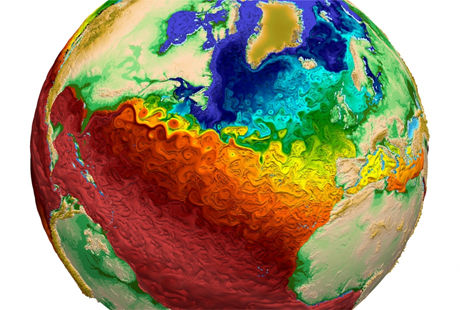
Figure 1: An advanced climate model showing temperature and currents in the ocean. This is the detail that new models are developing. Courtesy of Climate Central.
In conclusion, climate modeling, and weather modeling, is complex process that accurately describes what we can expect to occur. Theses models are analyzed via statistical methods, and are programmed to give results in those. Statistically speaking, 100% and 0% are almost never correct answers, and even high confidence results have a necessary amount of variance to them. These models are limited by the amount of available data and computer power, both of which are limited primarily by available funding, what isn’t. So, if those last fractions of a degree of accuracy are important to you, you could help gain those by funding further studies into this phenomenon.
Image Source: Figure 1: https://www.climatecentral.org/news/one-image-future-climate-models-18844
 Global Climate Change and Society