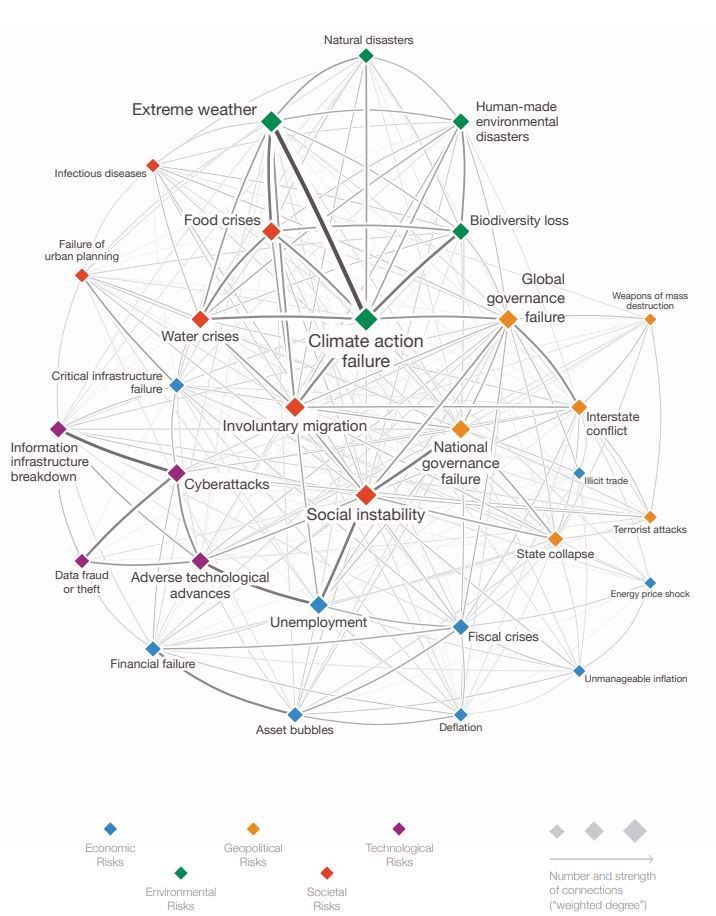
Many people do not realize that Climate Change directly affects the spread of diseases. These diseases can be carried by humans, insects, animals, or the air. Infectious diseases kill about 4 million people each year globally and call for funding basic health services, ending vectors of disease, and bettering vaccination services and programs. Besides health emergencies from extreme weather events, climate change causes an increase in malnutrition, the spread of infectious diseases, and leads to air pollution that is linked to 7 million deaths globally per year alone.
Preparing for epidemics that could bring a devastating death toll requires nations to strengthen their focus on global preparedness. Investing in health care workers is a big one. There’s expected to be a shortage of 18 million workers by 2030. Hygiene (which shouldn’t need to be taught, people should know how to clean themselves) in all health centers should be mandatory and improved. Being able to answer medical questions should be an expectation to anyone in the healthcare field. This will build more public trust in health institutions to fight people (such as politicians) that are misinformed by how things work (such as climate change and health epidemics).
Antimicrobial Resistance (AMR) is the development by a disease-causing microbe, through mutation or gene transfer, of the ability to survive exposure to an antimicrobial agent that was previously an effective treatment. Rising global temperatures may raise antibiotic resistance as well as increase the risk of future epidemics. Dengue Fever is a good example of this. Currently dengue fever is an epidemic in over 100 countries and there’s approximately 100,000,000 cases per year. According to a study done in Latin America using a computer to investigate models of the impacts of global mean temperatures 1.5 degrees Celsius, 2 degrees Celsius, and 3.7 degrees Celsius, the increase in dengue fever would mostly affect Southern Mexico, the Caribbean islands, Northern Ecuador, Columbia, Venezuela, and the coast of Brazil. If global warming stopped at 1.5 degrees Celsius, the cases of dengue fever would drop 0.3 million cases by 2050 and 0.5 million cases by 2100. Otherwise, rising temperatures could contribute to 7.5 million more dengue fever cases per year by 2050.
GLASS was launched in October of 2015 to establish an approach to collecting, analyzing and sharing data on antimicrobial resistance worldwide. What is GLASS? GLobal Antimicrobial Resistance Surveillance System. They specifically assess drug resistance found in bacterial infections caused by Acinetobacter spp., Escherichia coli, Klebsiella pneumoniae, Neisseria gonorrhoeae, Salmonella spp., Shigella spp., Staphylococcus aureus and Streptococcus pneumoniae. It does not monitor Malaria or HIV. As of September of 2018, 52 countries have enrolled in GLASS. The most common antibiotic-resistant pathogens included E. coli, K. pneumoniae, S. aureus and S. pneumoniae, which were detected in 17 countries, followed by Salmonella spp., which was detected in 15 countries.
Intense cyclones can result in the spread of diseases (especially waterborne diseases like Malaria). When cyclone Idai and cyclone Kenneth hit Mozambique in March of 2019 there were 50,000 confirmed cases of Malaria and 7,000 cases of Cholera reported. 603 people died in total and 1,641 people were injured. Of those 603, 8 died from Cholera and an unknown number of people died from Malaria. Climate Change is expected to cause 250,000 deaths per year from 2030-2050. The causes would likely be Malnutrition, Malaria, Diarrhea, and Heat Stress.
So now we move onto the current Epidemic right now, the Coronavirus. You may ask yourself “Self, how is the Coronavirus related to Climate Change?”. Well I’m here to tell you that all epidemics are related to Climate Change. We are an increasingly mobile global population that cannot just stay in one place. People fly to and fro whether it is for work or for pleasure without even thinking “is it safe for me to fly if I don’t feel good?”. Obviously it’s not but you do it anyway because you don’t think and just do. Humans were made to do just that, think and do. In 2018 alone there were 4.2 BILLION AIR PASSENGER JOURNEYS! One person could spread their sickness so easily to any part of the world without thinking, hence epidemics and (dare I say) hence the Coronavirus. A solution to this is not only going to take cooperation from public and private leaders but the general public as well.
Now let’s talk about how this epidemic is going to affect Climate Change personally. Governor Wolf just asked for a statewide shutdown of all nonessential companies to shut their doors. This means restaurants, stores, specialist doctor offices, theaters, and playgrounds. President Trump has asked all Americans to not travel unless it is absolutely necessary. He has also asked us not to be in crowds bigger than 10 people. Some people have that many living in their homes. This means people are going to be confined to their homes and this is good in some aspects for Climate Change. No traveling means no airplanes running and less emissions into the atmosphere. It also means less people driving long distances like vacations or going back and forth from school. Overall, less carbon emissions by cars, planes, busses, vans, etc., is going to be the break that the environment needed. There’s no saying how long this will last but I’m sure that the Earth will enjoy its break while it lasts.
This isn’t me saying that emissions are going to disappear because of people becoming self quarantine in their homes. They will still run electricity, air conditioning, gas, and petroleum. All of these still add to the problem of Global Warming but I’m simply just saying that we are cutting back whether we like it or not with transportation. Who knows, maybe this new way of life could last a while and we get used to it.
Thank you for reading!
Serina K. Croyle
Sources:
“Climate Change Is Making It Harder to Tackle Epidemics: Report.” Global Citizen, http://www.globalcitizen.org/en/content/climate-change-making-epidemics-worse/.
Healio. “Left Unchecked, Global Warming May Shape Future Epidemics.” Healio, 4 June 2018, http://www.healio.com/infectious-disease/emerging-diseases/news/online/{9fb0b2fb-218a-41bf-85b2-58a74d5b95e6}/left-unchecked-global-warming-may-shape-future-epidemics.
O’Reilly, Eileen Drage. “Epidemics, Socioeconomic Inequalities and Climate Change Are This Decade’s Global Challenges, per WHO.” Axios, 20 Jan. 2020, http://www.axios.com/who-emerging-health-challenges-pandemic-climate-change-inequalities-f83e0dd1-6d00-40c4-aaca-11523270648c.html.
Vaughan, Adam. “How Deadly Disease Outbreaks Could Worsen as the Climate Changes.” New Scientist, 15 Oct. 2019, http://www.newscientist.com/article/2219981-how-deadly-disease-outbreaks-could-worsen-as-the-climate-changes/.
Zhang, Jennifer, et al. “Coronavirus Response Shows the World Is Not Ready for Climate-Induced Pandemics.” State of the Planet, 1 Apr. 2020, blogs.ei.columbia.edu/2020/02/24/coronavirus-climate-induced-pandemics/.
 Global Climate Change and Society