Compiled by Brendan Wissinger
For my second topic I will be talking about climate change and droughts. Droughts are alarming because communities can run low or even run out of water, and crops can die from droughts and water is needed for many different power plants for example nuclear and hydropower and this may cut off electricity and combined with the heatwaves that usually go alone with droughts this can lead to deadly consequences.
Again the climate change driven droughts are happening now, and they are a current concern. Let’s take a trip around the world again to see these impacts first stop is California. Between 2012 and 2014, climate change intensified a drought in California by 15 to 20%. This was projected to cost the economy of California $2.7 billion per year. The drought caused crops to die and injured livelihoods. Much of the fruits and vegetables in the US come from California. Attribution studies have also linked this heatwave to Climate Change. Another area where droughts have been persistent is Australia. In Communities Australia people are leaving as they lose jobs from the drought and the communities are becoming poorer and smaller ghosts of themselves and they have to sell their livestock and move away. Much of Eastern Australia has been having drier than normal conditions since 2013 (with the exception of 2016) until at least 2018. The droughts have been the worst in western Queensland. Droughts have gotten worse through 2018. The hot weather can kill crops and drier soils can also kill crops or decrease yields. The soil has been the driest its been in 105 years in many areas of New South Wales. This also is partly attributed to Climate Change. This drought caused large wildfires in Australia. Our next stop on our tour of misery is East Africa. The droughts in the poor areas of the Horn of Africa have been the worst in 60 years in large areas of Somalia, Ethiopia, Djibouti and Kenya. Over 11 million people are affected were affected between 2011 and 2012, leading to large scale famine. Again in 2017 drought has occurred again and it is still ongoing. More than 12 million people are going starving. Eighty percent of the population relies on subsistence farming where they only can make enough food to feed themselves and their families and the drought they destroys their crops leaves them with little options. Currently these areas are facing a swarms of locusts. When rain does occur it comes in downpours that also destroys crops. Many are leaving these countries as environmental refugees living in refugees camps in areas on the outskirts of this crisis for example Kenya. This drought has also been partly attributed to climate change. Another area where droughts are of concern is Syria. The drought in Syria which lasted about 15 years, was the worst in 900 years! Because of the drought there was a failure in 75% of Syria’s farms and 85% of livestock died between 2006 and 2011. This failure of agriculture, caused over 1.5 million Syrian internal environmental refugees which moved to cities which could not or would not accommodate them, leaving them hungry, homeless and angry. This situation helped catalyze the uprising to the dictator of Syria that caused the Syrian Civil War which killed around 511,000 people and displaced 12.2 million people. This drought has also attributed to Climate Change. The Last Place on our tour is South Africa where drought has been getting worse from 2018 onward and a major city in South Africa almost ran out of water. The southern Africa, droughts have led to food shortages affecting 45 million people. To make matters worse this past year the droughts were interluded by cyclones. Countries affected include Democratic Republic of the Congo, Malawi, Mozambique, Tanzaina, Zambia, Zimbabwe and South Africa. Worse affected were the countries of Zambia and Zimbabwe. Grain production has decreased by 30 percent and Zimbabwe is running out of corn. Livestock has suffered loses from starvations. Here, drought has been a problem for several years. Cape Town, South Africa was close to running out of water, and having to have the water system shut off. Other impacts include California having the driest year on record in 2013, and in 2011 Texas had its driest year.
The Impacts of droughts can be economic, or human costs, indirect or direct. Droughts impact agriculture and kill crops for example corn, soybeans and wheat from not enough water. Also heatwaves that usually go with droughts can kill crops because of the heat. The lack of water can lead to dehydration or starvation of livestock and the heat can also kill livestock. This may cause a farmer to lose much of their yearly income and if their a subsistence farmer who only makes enough normally just to live off of, it can be deadly. Also droughts may increase the funds needed for water and feed for animals and irrigation. This all leads to higher food prices and in extreme cases famine. Droughts can also affect transportation on major canals and rivers by decreasing water levels. Also heatwaves that go with droughts can buckle roadways, and rail infrastructure. Droughts also allow wildfires to spread, and coupled with the heat goes with them can make a deadly mix. Millions of acres and thousands of homes have been lost because of fires in the past decade. Wildfires are expected to be six times larger in 20 years. Droughts can decrease the water getting to steam turbines used in nuclear and coal fired power plants, and decrease water used for cooling in Nuclear power plants, and decreased water levels are problematic for hydropower plants. And when droughts and heatwaves go together more people are using their air conditioning complicating matters. Also the heatwaves that usually coincide with droughts can kills hundreds or thousands, sometimes tens of thousands (like the 2003 European Heatwave killed 70,000 people) of people. Droughts can lead to an increase in disease in wild animals with less supplies for food and water which itself is problematic. Droughts can also destroy habitats for example forests, through forest fires, wetlands, and ponds through evaporation and drainage. The heatwaves that coincide with droughts can exacerbate air pollution leading to deaths from that. Also droughts and famines often can lead to societal stress that causes wars and conflict. For example the Syrian Civil War was preceded by a long drought that led to shortages of food and loss of livelihoods which was part of catalyst for the war which has killed over 500,000 people. The US Department of Defense has named Climate Change a “threat multiplier” for this reason. As people lose their livelihoods or cannot get food, societies are pushed to collapse, leading to wars, terrorism and refugees. Also wars over resources for example food and water will likely increase in the future. Also long lasting droughts can displace persons leading to environmental refugees, and causing mass migrations.
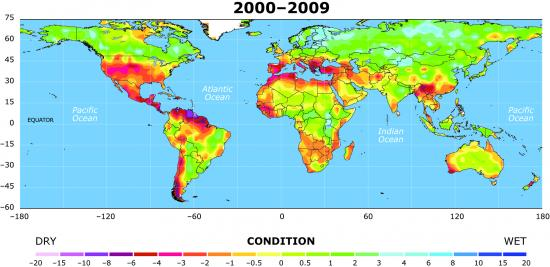
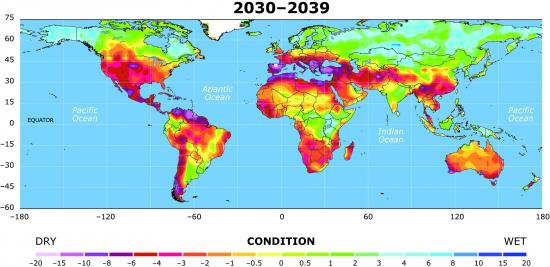
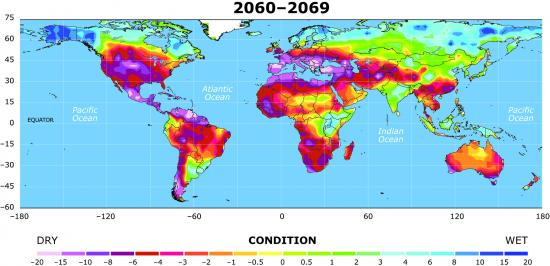
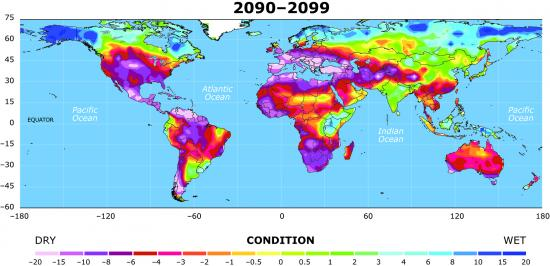
Projections of Climate Change suggest that warming will cause droughts to get hotter and longer, and rain to happen less often but when it does come it will come in severe downpours, flooding areas. In general drier areas on Earth are expected to get drier and wetter areas are expected to get wetter. Its expected to get a lot worse in the future. At current rates of emissions and warming we could see droughts lasting on and off for decades in the Southwestern US, meaning the entire climate there would change to be drier. Again the countries that will be worst affected will be developing countries, especially African countries. In areas fed by glaciers, the melting of glaciers from climate change can leave areas without water, this is especially important in India, Pakistan and Nepal and Tibet and surrounding areas, leading to shortages of food from drought. Many regions are entering droughts that are almost consistent, leading scientists to question if they are the new normal. Below are some projections of droughts and floods around the world.
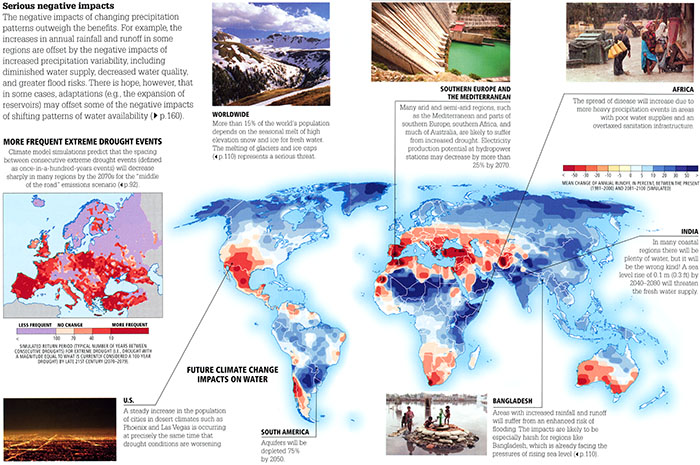
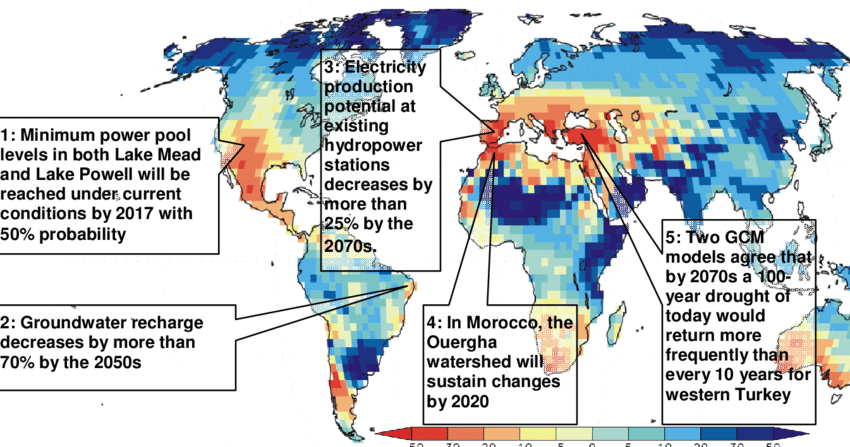
Actually there are several different times of droughts that lead from one to the next and not all droughts go through each type. First there is a meteorological drought or a drought relating to weather where there is little or no precipitation. Second there is hydrological drought when there is a low water supply in rivers and in groundwater which occurs after many months of meteorological drought. After a hydrological drought there is an agricultural drought which is when yields drop or crops fail due to a lack of water. Lastly there is a socioeconomic drought when water to communities and food and other products like energy are not able to be bought or sold because of the drought. Usually a hydrological drought will take a long time to be fixed unlike a meteorological drought. Also there are many causes to a drought 1) there is a drought related to high temperatures, which is when heatwaves move through they require agriculture and communities to use more water to hydrate humans and crops and cool machinery and animals so the demand increases, 2) the weather causes droughts either from high pressure systems lasting for long times or climatic oscillations like El Nino and La Nina, 3) as a drought continues or as soil moisture goes down there is less water to cause precipitation, so this is a positive feedback loop on droughts, but usually weather doesn’t stay in one location and moves and usually where the majority of evaporation occurs is not the same place precipitation occurs, 4) Higher demand for water can cause drought, for example Lake Mead which supplies water for Arizona, Nevada, and California is decreasing in size not just due to a 19 year drought, its also due to rising demand for the water. So this means that usually drought is connected to meteorological factors but not always. 5) The timing of when the water comes doesn’t coincide with the agricultural season leading to water shortages and crops not able to be grow. It may also be hard to tell when a drought is coming because they are slowly happening. Also climate change causing intense downpours really doesn’t help alleviate the drought it creates because usually intense rains run right into rivers and streams and back out to sea, and the ground gets overly saturated, and excess is washed away and the soil dries up after a while, while a slower more steady rainfall would allow more water to be soaked up by the soil.
To adapt to these droughts and heatwaves we can implement better water capture and storage systems, increasing energy efficiency in buildings, increasing the ability to store food, increasing international aid to developing countries, using genetic engineering to create drought resistant crops. We can also create more water efficient appliances and housing and regulate and limit water use for non-essential things. We can use alternative water supplies, desalination, limit water use when water is scarce, reduce water pressure in water pipes and use public relation campaigns to push for less water use. We can also change water rights laws so people who have the most rights are not the people who get their first or pay the most, but the people who need the most for the most essential activities.
Next week: War and Conflict.
Mann, Michael et al. Dire Predictions. https://www.nytimes.com/2014/03/17/us/wests-drought-and-growth-intensify-conflict-over-water-rights.html https://earthobservatory.nasa.gov/images/51411/severe-drought-causes-famine-in-east-africa https://www.thenewhumanitarian.org/feature/2017/03/17/drought-africa-2017
https://www.un.org/africarenewal/web-features/famine-somalia
https://www.actionaid.org.uk/about-us/what-we-do/emergencies-disasters-humanitarian-response/east-africa-crisis-facts-and-figures https://www.smithsonianmag.com/innovation/is-a-lack-of-water-to-blame-for-the-conflict-in-syria-72513729/ https://www.nytimes.com/2015/03/03/science/earth/study-links-syria-conflict-to-drought-caused-by-climate-change.htmlhttps://www.vice.com/en_us/article/3kw77v/the-drought-that-preceded-syrias-civil-war-was-likely-the-worst-in-900-yearshttps://www.theguardian.com/environment/2016/mar/02/syrias-drought-has-likely-been-its-worst-in-900-yearshttps://www.hrw.org/world-report/2019/country-chapters/syria https://earthobservatory.nasa.gov/images/146015/drought-threatens-millions-in-southern-africa https://www.weforum.org/agenda/2019/08/cape-town-was-90-days-away-from-running-out-of-water-heres-how-it-averted-the-crisis/ https://www.forbes.com/sites/kensilverstein/2019/11/07/for-southern-africa-climate-change-is-real-as-prolonged-droughts-are-creating-food-shortages/#73e4e8ef43f7 https://www.globalcitizen.org/en/content/southern-africa-drought-water-climate-change/https://climate.nasa.gov/news/2881/earths-freshwater-future-extremes-of-flood-and-drought/https://www.nytimes.com/2018/12/12/climate/climate-change-floods-droughts.html https://www.forbes.com/sites/lauratenenbaum/2019/10/15/climate-change-impacts-monsoon-flooding-in-india/#3765a98d4550 https://www.c2es.org/content/drought-and-climate-change/https://www.reuters.com/article/us-asia-water-glaciers/melting-glaciers-threaten-asias-drought-buffer-scientists-warn-idUSKCN1SZ2AG https://www.ucsusa.org/resources/drought-and-climate-change
https://eos.org/features/how-will-climate-change-affect-the-united-states-in-decades-to-come https://www.slashgear.com/nasa-drought-study-human-climate-change-impact-research-02575363/https://www.cnn.com/2019/05/01/health/drought-human-caused-scn/index.html
http://www.climatechange-foodsecurity.org/drought.html
http://www.cgd.ucar.edu/cas/adai/news/Dai_Drought_UCAR.htm
https://www.eea.europa.eu/data-and-maps/figures/projected-impacts-of-climate-change
https://www.ncdc.noaa.gov/monitoring-references/dyk/drought-definition https://jainsusa.com/blog/drought/ https://www.bbc.com/news/science-environment-50602971 https://www.vox.com/2016/5/23/11736340/lake-mead-water-drought-southwest https://www.nytimes.com/2019/03/19/climate/colorado-river-water.html
https://www.carbonbrief.org/guest-post-climate-change-is-already-making-droughts-worse https://www.bbc.com/news/world-africa-13944550 http://www.bom.gov.au/climate/updates/articles/a010-southern-rainfall-decline.shtml https://www.theguardian.com/environment/ng-interactive/2018/oct/03/the-new-normal-how-climate-change-is-making-droughts-worse https://oxfamblogs.org/fp2p/is-climate-change-to-blame-for-the-east-african-drought/ https://www.c2es.org/content/drought-and-climate-change/ https://drought.unl.edu/Education/DroughtforKids/DroughtEffects.aspx
https://www.carbonbrief.org/droughts-and-heatwaves-cause-10-drop-in-annual-crop-harvests https://www.outsideonline.com/2289216/20-years-wildfires-will-be-six-times-larger https://www.carbonbrief.org/daily-brief/climate-change-intensifies-california-drought-scientists-say https://www.nytimes.com/2015/08/21/science/climate-change-intensifies-california-drought-scientists-say.html?auth=login-google&emc=rss&partner=rss&utm_campaign=65eb9fd7f9-cb_daily&utm_medium=email&utm_source=Daily%20Carbon%20Briefing&utm_term=0_876aab4fd7-65eb9fd7f9-303449629
https://www.dw.com/en/drought-crisis-in-the-horn-of-africa/a-38950292 https://www.aljazeera.com/indepth/inpictures/horn-africa-millions-suffering-due-prolonged-drought-190318055110862.html https://www.forbes.com/sites/dennismersereau/2018/06/19/how-can-drought-set-after-so-much-heavy-rain-its-easier-than-you-think/#1e92ed6061d5
 Global Climate Change and Society
I will get to fixing this mess of citations on over Spring Break, not that will my grade (understandably), but so its more readable and I feel better about myself. I am going to move on to more homework now.
LikeLike
I thought you did a nice job bring awareness and the effects of droughts in different parts of the world. Also about places that are
Less fortunate and don’t any means or resources to try to help deal with the situations better, very sad. Thank your for writing about all of the different situations and how different part of the world are effected.
LikeLiked by 1 person
Thanks!!
LikeLike